
Dermestes ater
De Geer, 1774
black larder beetle, incinerator beetle
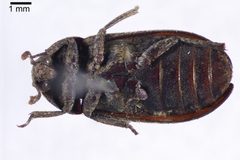
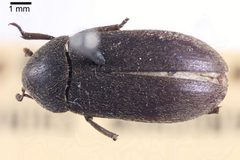
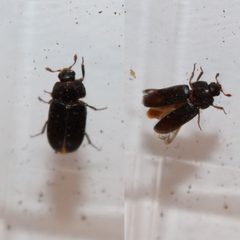
Dermestes ater is a dermestid native to North America but now found nearly worldwide. measure 7–9 mm with black or brown covered in yellowish hairs; males are distinguished by a row of bristles along the . The is a significant pest of stored products, feeding on dried animal and plant materials including cured meats, cheeses, leather, wool, and fish. It also functions as an occasional and scavenger, consuming dead insects, carrion, and even pupae. The beetle has forensic importance due to its presence on human corpses, and veterinary significance as a of in poultry facilities.
Pronunciation
How to pronounce Dermestes ater: //dɛrˈmɛstɛs ˈɑːtər//
These audio files are automatically generated. While they are not always 100% accurate, they are a good starting point.
Identification
Distinguished from Dermestes haemorrhoidalis and D. peruvianus by sternal impressed lines that angle inward toward base rather than remaining parallel to side margin throughout length. Abdominal sternites show symmetrical light-dark pattern with dark areas near edges, versus different patterns in related . Larvae distinguished from close relatives by urogomphi directed backward but appearing nearly straight in side view, and by presence of approximately 30 short erect setae on abdominal tergites 4–9 to transverse ridge (other species have far fewer).
Images
Habitat
Stored product facilities, warehouses, rearing facilities, poultry houses, traditional fish processing settings, carrion decomposition sites including vehicle environments and cadavers. Associated with accumulated dead insects in light fixtures and wall voids containing rodent carcasses.
Distribution
Native to North America; now with established worldwide including Malaysia, Zambia, Australia, India, and the Galápagos Islands. Present throughout Florida and other regions with stored product or animal husbandry operations.
Diet
Dried and cured animal products including cheese, dried fish, leather, copra, silk, wool, milk powder, hog bristles; dried mushrooms, cacao, ginger, and other stored plant materials; dead insects and carrion; live pupae and ; house fly larvae and pupae in poultry facilities. Adults occasionally cannibalize larvae and pupae; larvae may consume and each other.
Host Associations
- silkworm (Bombyx mori) - attacks cocoons, pupae, and ; damages silk cocoons during feeding
- house fly (Musca domestica) - consumes larvae and pupae in poultry houses and other congregating sites
- caged layer hens - associateinhabits manure in poultry facilities; involved in transmission of cestoid to birds
- human corpses - decomposercolonizes cadavers in forensic settings including vehicle environments
Life Cycle
Female lays 1–25 whitish approximately 2 mm long, deposited directly in food source. Eggs hatch in few days depending on temperature. Larva passes through six to nine instars over 19–50 days depending on temperature, humidity, and food availability. Larva pupates within last shed , often boring into soft solid material such as cork. Pupal period lasts several days. lives approximately 169 days depending on temperature. time variable; under optimal conditions cycle completes in 40–50 days, more commonly one generation per year.
Behavior
Exhibits Type III to prey when feeding on house flies, with reduced searching time at higher prey densities. and larvae cannibalize conspecifics when crowded. Adults are capable fliers. Larvae wander in search of new food sources and sites. When disturbed, related in show (death feigning), though this specific not explicitly documented for D. ater.
Ecological Role
Decomposer of dried animal matter and nutrient cycler in natural settings; forensic for postmortem interval estimation; potential agent for house fly in confined animal facilities; pest of stored products and museum collections; of chicken tapeworms in poultry operations.
Human Relevance
Major pest of stored food products, animal fibers, and museum specimens. Damages silk industry by destroying cocoons. Veterinary concern due to transmission in poultry. Forensic utility in criminal investigations involving decomposing remains. Controlled through proper storage in sealed containers, cedar chests for fabrics, and .
Similar Taxa
- Dermestes haemorrhoidalisAlso called African larder beetle or sometimes black larder beetle; distinguished by sternal impressed lines that remain parallel to side margin throughout length rather than angling inward
- Dermestes peruvianusSimilar sternal structure to D. haemorrhoidalis with parallel impressed lines; both differ from D. ater in this character
- Dermestes lardariusCommon larder beetle with similar habits but distinguished by prominent yellow band across versus uniform dark coloration in D. ater
More Details
Forensic Importance
Documented from human corpses in vehicle environments and other decomposition scenes, contributing to insect analysis and postmortem interval estimation.
Chemical Defense
Possesses lipids containing esters of carboxylic acids and other volatile compounds, though specific defensive function not detailed in available sources.
Sources and further reading
- BugGuide
- Wikipedia
- GBIF taxonomy match
- iNaturalist taxon
- NCBI Taxonomy
- Bug Eric: Larder Beetle
- Bug Eric: More Beetles from Bones
- New Analysis Refines Taxonomy of Dermestid Beetles
- Bug Eric: What's in Dat Scat?
- Bug Eric: Beetles from Bones
- A rare opportunity to do fall insect collecting in western North America | Beetles In The Bush
- Black larder beetle, incinerator beetle, Dermestes ater DeGeer (Insecta: Coleoptera: Dermestidae)
- Application of headspace solid‐phase microextraction followed by gas chromatography coupled with mass spectrometry to determine esters of carboxylic acids and other volatile compounds in Dermestes maculatus and Dermestes ater lipids
- Consequences of refuge for the functional response of Dermestes ater (Coleoptera: Dermestidae) to Musca domestica (Diptera: Muscidae)