Stephanopachys cribratus
(LeConte, 1866)
Sifting Powderpost Beetle, Horned Powder-post Beetle
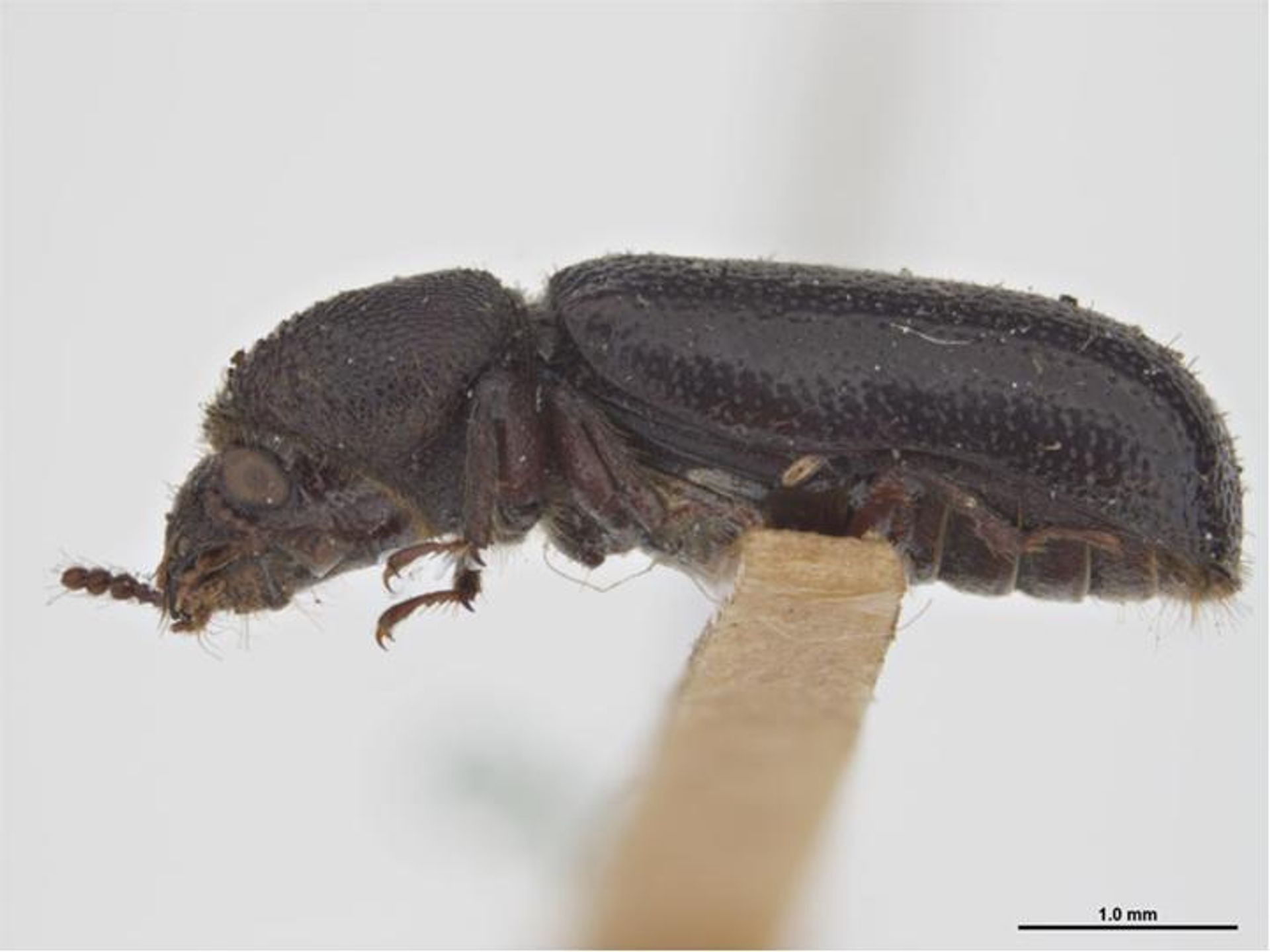
Stephanopachys cribratus is a small in the Bostrichidae, commonly known as the Sifting Powderpost Beetle. It occurs in North America, primarily east of the Rocky Mountains. The is characterized by its dark brown coloration and small size, measuring 3.5–5.0 mm in length. Like other members of Bostrichidae, it is associated with wood-boring habits.
Pronunciation
How to pronounce Stephanopachys cribratus: //ˌstɛfənoʊˈpækɪs krɪˈbreɪtəs//
These audio files are automatically generated. While they are not always 100% accurate, they are a good starting point.
Identification
The combination of small size (3.5–5.0 mm), dark brown coloration, and geographic distribution east of the Rocky Mountains helps distinguish this from other North American Bostrichidae. The Stephanopachys is distinguished from related genera by antennal and pronotal characteristics, though specific diagnostic features for S. cribratus require examination of detailed morphological characters not provided in general sources.
Images
Appearance
Dark brown in color. Body length ranges from 3.5 to 5.0 mm. As a member of Bostrichidae, possess a somewhat cylindrical body form typical of powderpost beetles. The epithet 'cribratus' (meaning 'sieved' or 'perforated') may refer to punctation or surface texture, though this is not explicitly documented in available sources.
Distribution
North America, particularly east of the Rocky Mountains. Documented from Canadian provinces including Alberta and British Columbia, suggesting broader distribution than the 'east of Rockies' characterization may imply.
Similar Taxa
- Other Stephanopachys speciesCongeneric share the -level characteristics of antennal club structure and pronotal form; S. cribratus is distinguished by specific combinations of size, coloration, and distribution.
- Other Bostrichidae (powderpost beetles) members share wood-associated habits and cylindrical body form; Stephanopachys is distinguished by subtribe-level characters including antennal .
More Details
Nomenclature
The was described by John Lawrence LeConte in 1866, a prominent American entomologist who described numerous North American beetles.
Common name origin
The 'Sifting Powderpost ' likely derives from the Latin 'cribratus' (sieved/sifted), referring to the perforated or punctate appearance of the body surface.