
Scobicia bidentata
(Horn, 1878)
horned powder-post beetle
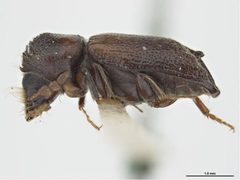
Scobicia bidentata is a of horned powder-post beetle in the Bostrichidae, first described by Horn in 1878. The species is distributed across North America, with records from Canada and the United States. Like other members of its family, it is associated with wood-boring habits. The specific epithet "bidentata" refers to a two-toothed characteristic, likely describing a morphological feature of the species.
Pronunciation
How to pronounce Scobicia bidentata: /skoˈbɪʃiə baɪdənˈteɪtə/
These audio files are automatically generated. While they are not always 100% accurate, they are a good starting point.
Identification
The name "bidentata" suggests the presence of two teeth or tooth-like projections, likely on the , pronotum, or other sclerotized structures. As a member of the "horned powder-post beetles," it presumably exhibits the characteristic of a hood-like pronotum that extends forward over the . Definitive identification requires examination of specific morphological features including antennal club structure, pronotal shape, and elytral sculpturing, which distinguish it from congeneric species such as Scobicia declivis.
Images
Habitat
Associated with woody substrates, consistent with the wood-boring of the Bostrichidae. Specific microhabitat preferences are not documented.
Distribution
North America, including Canada (Ontario) and the United States.
Human Relevance
As a powder-post beetle, it may contribute to wood degradation, though its specific economic impact has not been documented.
Similar Taxa
- Scobicia declivisCongeneric requiring careful morphological examination to distinguish; differences likely in pronotal and elytral features.
- Other Bostrichidae members share wood-boring habits and general body form; identification to level requires detailed examination of taxonomically significant characters.
More Details
Etymology
The specific epithet "bidentata" is derived from Latin "bi-" (two) and "dentata" (toothed), referring to a diagnostic morphological feature of the .