
Dendrobiella
Casey, 1898
horned powder-post beetles
Species Guides
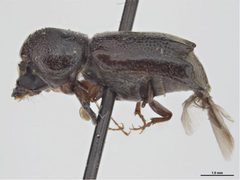
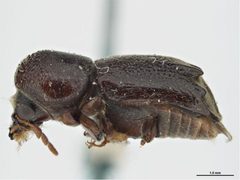
2- Dendrobiella aspera(horned powder-post beetle)
- Dendrobiella sericans(Four-toothed Texas Bostrichid)
Dendrobiella is a of horned powder-post beetles in the Bostrichidae, established by Casey in 1898. The genus contains approximately seven described distributed primarily in North and Central America. Members of this genus are wood-boring beetles associated with dead or dying woody vegetation.
Pronunciation
How to pronounce Dendrobiella: /dɛnˌdroʊ.biˈɛl.lə/
These audio files are automatically generated. While they are not always 100% accurate, they are a good starting point.
Identification
Dendrobiella can be distinguished from other Bostrichidae by features of the pronotum, which bears a pair of horn-like projections in males—a characteristic shared with related genera in the tribe Xyloperthini. -level identification requires examination of antennal club structure, elytral , and patterns. The genus is most similar to Xylopertha but differs in details of pronotal armature and male genitalia.
Images
Habitat
Associated with dead, dying, or recently cut woody vegetation including branches and logs of various hardwoods and conifers. Specific microhabitat preferences vary by but generally involve seasoned or partially decayed wood rather than freshly fallen material.
Distribution
North America and Central America. occur from the United States (particularly southwestern and southern regions) through Mexico to Panama. Dendrobiella aspera and D. sericans are recorded from the southwestern United States; D. isthmicola occurs in Central America.
Behavior
are and attracted to light. They bore into wood to create galleries for -laying and larval development. The 'powder-post' refers to the fine, powdery produced by larval feeding.
Ecological Role
Decomposers of dead wood, contributing to nutrient cycling in forest . Their wood-boring activity accelerates the breakdown of fallen branches and standing dead timber.
Human Relevance
Occasional pests of seasoned lumber and wooden structures, though generally less economically significant than some other Bostrichidae . Not considered a major structural pest.
Similar Taxa
- XyloperthaShares the tribe Xyloperthini and similar pronotal horn development; distinguished by differences in antennal structure and male genital .
- BostrichusAnother horned powder-post beetle in the same ; differs in pronotal shape and degree of in horn development.
- ApatidesSimilar size and wood-boring habit; lacks the pronounced pronotal horns characteristic of Dendrobiella males.
More Details
Species Diversity
The includes seven described : D. aspera, D. isthmicola, D. leechi, D. pubescens, D. sericans, D. sericea, and D. sublaevis. Several species were originally described in other genera and later transferred to Dendrobiella.
Taxonomic History
Casey established Dendrobiella in 1898, with D. pubescens as the type . The has remained relatively stable in its circumscription, though species-level has been revised multiple times, particularly by Lesne (1933) and subsequent .