
Micrapate bilobata
Fisher, 1950
horned powder-post beetle
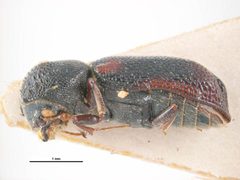
Micrapate bilobata is a of powder-post beetle in the Bostrichidae, first described by Fisher in 1950. It is characterized by horn-like projections on the , a trait common among male bostrichids. The species is found in North America. As with other members of its family, it is associated with wood-boring habits.
Pronunciation
How to pronounce Micrapate bilobata: //mɪˈkɹæpeɪt biːloʊˈbɑːtə//
These audio files are automatically generated. While they are not always 100% accurate, they are a good starting point.
Identification
Distinguished from other bostrichids by the combination of horned structure and specific features of the bilobed (two-lobed) configuration referenced in the epithet. Separation from in Micrapate requires examination of genitalic and pronotal characters not detailed in general sources.
Images
Appearance
Habitat
Associated with woody substrates, consistent with the wood-boring of Bostrichidae. Specific plant or substrate preferences have not been documented.
Distribution
Recorded from North America. Precise range boundaries and country-level distribution are not specified in available sources.
Seasonality
activity period has not been documented.
Behavior
Presumed to exhibit wood-boring larval development and tunneling characteristic of Bostrichidae, though direct observations of M. bilobata have not been published.
Ecological Role
Contributes to wood decomposition and nutrient cycling in forest through larval tunneling in dead wood.
Human Relevance
May occasionally infest seasoned wood or wooden structures, as some bostrichids are known to do, though specific economic impact of this has not been reported.
Similar Taxa
- Other Micrapate speciesShare horned ; require detailed morphological examination to distinguish.
- Dinoderus speciesSimilar cylindrical body form and wood-boring habits, but lack prominent cephalic horns.
- Other BostrichidaeGeneral resemblance in body shape; horn presence and configuration separate Micrapate from hornless .
More Details
Taxonomic history
Described by Fisher in 1950. The specific epithet 'bilobata' refers to a two-lobed structure, likely describing a feature of the horns or pronotum.
Data gaps
No published studies specifically addressing the , , or of this were located in major databases. Most information is inferred from -level characteristics.