
Lichenophanes fasciculatus
(Fall, 1909)
horned powder-post beetle
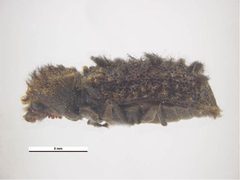
Lichenophanes fasciculatus is a of horned powder-post beetle in the Bostrichidae. It is found in North America. As a member of the Bostrichidae, it belongs to a group of beetles commonly known as powder-post or false powder-post beetles, many of which are associated with wood-boring habits.
Pronunciation
How to pronounce Lichenophanes fasciculatus: //lɪˌkɛnoʊˈfeɪniːz ˌfæˌsɪkjʊˈleɪtəs//
These audio files are automatically generated. While they are not always 100% accurate, they are a good starting point.
Identification
Distinguished from other Bostrichidae by features of the Lichenophanes, which can be separated from related genera by characteristics of the pronotum and . The specific epithet 'fasciculatus' may refer to bundling or clustering features, though the precise diagnostic characters require examination of . Identification to level requires knowledge of Bostrichidae and comparison with described specimens.
Images
Appearance
As a horned powder-post beetle in the Lichenophanes, this likely exhibits the characteristic robust, cylindrical body form typical of Bostrichidae. Members of this genus often have a pronotum that extends forward over the , sometimes with horn-like projections in males. The body is typically dark brown to black, with a somewhat shiny or polished appearance. are relatively short and may be clubbed. The overall body shape is compact and adapted for burrowing into wood.
Habitat
Specific details for this are not documented. Members of the Bostrichidae are generally associated with dead or dying wood, including hardwoods and softwoods. Some species are attracted to recently dead branches or trunks, while others may colonize seasoned wood.
Distribution
Recorded from North America. The precise geographic range within North America is not well documented in available sources.
Seasonality
Activity period is not documented for this . Many Bostrichidae are active during warmer months, with and activity influenced by temperature and wood condition.
Life Cycle
details are not documented for this . Bostrichidae typically have larvae that bore into wood, feeding on cellulose and creating tunnels. Development time varies with wood type and environmental conditions. may emerge to mate and seek new material.
Behavior
Behavioral observations are not documented. Bostrichidae are generally or , with often attracted to lights. They are capable of and may be found on dead wood or in flight during active periods.
Ecological Role
As a wood-boring , this likely contributes to decomposition of dead wood and nutrient cycling in forest . The ecological impact is presumed minor compared to more abundant saproxylic beetles.
Human Relevance
Economic importance is not documented for this . Some Bostrichidae are pests of seasoned wood or wooden structures, but most are not significant economic pests. The Lichenophanes is not among the most frequently reported pest genera in the .
Similar Taxa
- Other Lichenophanes speciesCongeneric share the general body plan and horned pronotum characteristics; precise separation requires examination of subtle morphological differences.
- Other Bostrichidae genera (e.g., Bostrichus, Dinoderus)Similar wood-boring habits and general body form, but differ in pronotal structure, antennal club shape, and other diagnostic features.
More Details
Taxonomic note
The was described by Fall in 1909. The Lichenophanes is part of the tribe Bostrichini within the Bostrichinae. Available sources provide minimal biological information beyond the basic taxonomic placement and geographic distribution.