
Amphicerus bicaudatus
(Say, 1824)
Apple Twig Borer, Grape Cane Borer
Amphicerus bicaudatus is a horned powder-post beetle in the Bostrichidae, commonly known as the apple or grape cane borer. It is recognized as a pest of cultivated orchard trees, grapevines, and other woody plants. The has been studied for its complex , with research showing periodic, quasiperiodic, and chaotic patterns depending on environmental and management factors.
Pronunciation
How to pronounce Amphicerus bicaudatus: /æmˈfaɪsərəs ˌbaɪˌkɔːˈdeɪtəs/
These audio files are automatically generated. While they are not always 100% accurate, they are a good starting point.
Identification
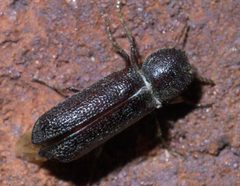
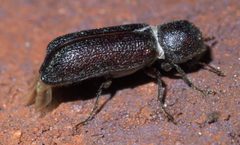
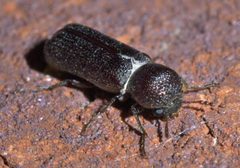
Distinguished from other Bostrichidae by its cylindrical body form and size range. The combination of color variation (reddish brown to black) and association with woody plants helps separate it from similar powder-post beetles. Larval identification relies on the white body with contrasting brown and .
Images
Appearance
are long and cylindrical, measuring 6–13 millimeters in length. Body color ranges from reddish brown to black. Larvae are white with a brown and , reaching approximately 10 millimeters in length.
Habitat
Associated with cultivated orchard trees, grapevines, and other woody tree . Inhabits twigs and canes of plants.
Distribution
Recorded from North America, with specific distribution records from Manitoba, Canada and the Northern Territory, Canada.
Diet
Larvae bore into and feed on woody tissues of plants including apple, grape, and other tree .
Host Associations
- Malus - pestorchard trees
- Vitis - pestgrapevines
- various tree species - pestother woody
Behavior
and larvae bore into twigs and canes of plants, causing damage to cultivated crops. have been observed to exhibit periodicity, quasiperiodicity, and under some conditions chaotic patterns.
Ecological Role
Pest affecting cultivated woody plants; are influenced by interactions with application, cane removal practices, and plant availability.
Human Relevance
Agricultural pest of economic significance in orchards and vineyards. Management involves application and physical removal of infested canes.
Similar Taxa
- Other BostrichidaeSimilar cylindrical body form; distinguished by association, size range, and coloration.