
Gyrinus minutus
Fabricius, 1798
whirligig beetle
Gyrinus minutus is a small whirligig beetle with a Holarctic distribution spanning northern North America and Eurasia. It is distinguished from by its weak swimming ability, solitary among emergent vegetation, and near-absence of volatile defensive compounds. The exhibits a shortened of approximately seven weeks from to and is capable of , allowing of new water bodies throughout the summer.
Pronunciation
How to pronounce Gyrinus minutus: /dʒaɪˈraɪnəs mɪˈnjuːtəs/
These audio files are automatically generated. While they are not always 100% accurate, they are a good starting point.
Identification
Weak swimming ability with less pronounced gyrations compared to other Gyrinus —obvious in the field. Solitary occurrence among emergent vegetation distinguishes it from aggregating . Lacks or produces minimal volatile compounds, so does not emit typical gyrinid scent detectable by human nose. Pronotal microsculpture with smooth line provides additional diagnostic character.
Images
Appearance
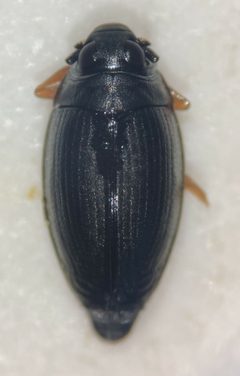
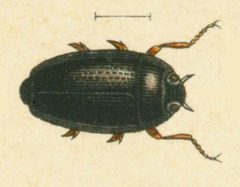
Body entirely black with dull appearance due to intricate microsculpture. Many individuals display an obvious metallic bronze sheen on the lateral . Underside and legs light brown to orange. Pronotum with narrow, smooth longitudinal central line contrasting with textured surface. Mesosternum with clear longitudinal groove. Males from southern Rocky Mountain (Wyoming, Colorado) slightly larger than Canadian males; females show minimal size variation.
Habitat
Open margins of larger water bodies including lakes and ; also sparsely vegetated ponds in moorlands and slow-flowing river sections. overwinter on submerged vegetation. Occupies more sheltered than many , reducing exposure to fish .
Distribution
Holarctic. North America: Canada (widespread in Northwest Territories, Yukon, Alaska; northern Manitoba and Saskatchewan; south to Edmonton, Alberta; Rocky Mountains of Wyoming and Colorado). Europe: northern regions from UK and Fennoscandia to Arctic Circle; absent from southern Europe and North Africa. Asia: northeastern China, Sakhalin, Hokkaido. UK distribution now largely northern and scattered; declined in southern England but remains common in Ireland, Scotland, Western Isles, and Shetland.
Seasonality
active year-round; winter spent submerged on vegetation. Active from February through late autumn with peak abundance mid-to-late summer. begins early spring with mating on water surface. Adults capable of and can appear at new locations throughout summer.
Life Cycle
Mating occurs on water surface in early spring, followed by -laying on aquatic plants in late spring. Eggs hatch after approximately one week. Larvae entirely aquatic, do not surface for oxygen; move among underwater plants as . Larval development rapid, reaching maturity in three to four weeks. Mature larvae leave water to construct cocoon on water margins or emerging plants. Pupal stage short, emerging within approximately one week. Complete from egg to adult spans about seven weeks in laboratory conditions.
Behavior
Swimming abilities weaker than other gyrinids; less pronounced gyrations visible in field. When disturbed, may dive or groups disperse by swimming away from disturbance. Typically solitary among emergent vegetation rather than forming on open water. Can respond to alarm signals from other Gyrinus despite minimal volatile production; occasionally associates with scented species on open water, possibly benefiting from their alarm signals ().
Ecological Role
Predatory larvae hunt among aquatic vegetation. and larvae occupy position in aquatic ; adults noted as prey for black tern and greenshank in Europe. Absence of volatile defenses correlates with reduced fish risk in sheltered vegetated .
Human Relevance
Subject of chemical research regarding loss of volatile alarm substances. declines in southern UK may reflect changes or climate factors. No significant economic impact documented.
Similar Taxa
- Gyrinus substriatusProduces 3-methyl-1-butanal and 3-methyl-1-butanol when irritated; commonly found in groups in rivers rather than solitary in vegetated .
- Gyrinus aeratusProduces volatile alarm compounds; inhabits open lake surfaces in , contrasting with G. minutus preference for sheltered vegetated edges.
More Details
Chemical defense reduction
G. minutus lacks or produces minimal volatile fraction in pygidial glands, unlike . This appears linked to solitary and sheltered preferences reducing pressure. Whether this represents secondary loss or ancestral absence remains unresolved.
Chromosomal features
pair 1 relative length approximately 14.5, decreasing evenly to 5.5 in pairs 7–13. Pair 10 with obvious secondary constriction. Majority autosomes metacentric or submetacentric; pairs 9 and 12 subacrocentric. X chromosome longest in , RCL ~20, metacentric.
Subgeneric classification
Only European of subgenus Gyrinulus Zaitzev.