
Boreonectes
Angus, 2010
Species Guides
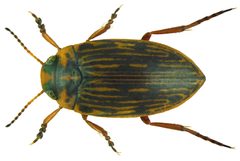
2Boreonectes is a of small predaceous diving beetles established by Angus in 2010, comprising approximately 16 described . The genus was separated from Deronectes based on morphological and cytogenetic evidence. Species occur across North America, the Neotropics, and the Palearctic, with West European species showing distinct chromosomal differentiation despite minimal genetic divergence. These beetles occupy cold-water including mountain lakes and barren pools, with some species extending to Arctic Scandinavia.
Pronunciation
How to pronounce Boreonectes: //ˌbɔɹ.joʊˈnɛk.tiːz//
These audio files are automatically generated. While they are not always 100% accurate, they are a good starting point.
Images
Habitat
Mountain lakes and barren pools; at lower altitudes in northern regions. Pyrenean of B. multilineatus occur in the only Boreonectes known from that range.
Distribution
North America, the Neotropics, and the Palearctic. West European include: Pyrenees (B. multilineatus only), inland Scandinavia, British Isles, Faroe Islands, and Ireland. Arctic Scandinavian ranges of B. griseostriatus and B. multilineatus are of recent post-glacial origin; fossil evidence places B. griseostriatus in Pleistocene Central European mountain sites (Starunia, Ukraine; England).
Similar Taxa
- DeronectesBoreonectes was historically classified within Deronectes; separated in 2010 based on morphological and cytogenetic characters including distinct numbers and secondary constrictions.
More Details
Cytogenetic differentiation
West European Boreonectes exhibit pronounced karyotypic differences: B. multilineatus has 28 pairs, while B. griseostriatus has 30. Species differ in numbers and locations of secondary constrictions and centromeric C-bands. These chromosomal differences contrast with minimal genetic () divergence, suggesting differentiation may have driven speciation.
Sex chromosome system
Male Boreonectes have X0 ; females have XX.