
Uvarus lacustris
(Say, 1823)
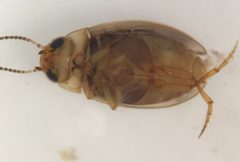
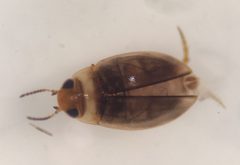
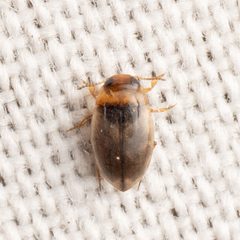
Uvarus lacustris is a small predaceous diving beetle in the Dytiscidae, first described by Thomas Say in 1823. It belongs to the tribe Bidessini within the Hydroporinae. The is documented from North America, with confirmed records from Canada (Ontario) and the United States. As a member of Dytiscidae, it is an aquatic , though specific ecological details remain poorly documented in published literature.
Pronunciation
How to pronounce Uvarus lacustris: /ˈu.va.rus laˈku.strɪs/
These audio files are automatically generated. While they are not always 100% accurate, they are a good starting point.
Identification
Uvarus lacustris can be distinguished from other North American diving beetles by its small size and placement in the tribe Bidessini, which comprises some of the smallest dytiscids. Members of the Uvarus typically exhibit reduced or modified male protarsal claws, a characteristic feature of the group. Positive identification to level requires examination of male genitalia and careful comparison with related species in the genus, particularly U. granarius and U. subtilis, which overlap in distribution. The species name 'lacustris' (meaning 'of lakes') suggests an association with lacustrine , though this alone is insufficient for field identification.
Images
Habitat
The epithet and placement suggest association with lentic (still water) , including lakes, ponds, and possibly slow-moving sections of streams. Members of the tribe Bidessini are generally found in diverse aquatic microhabitats, often in vegetated areas with detritus accumulation. Specific microhabitat preferences for U. lacustris have not been rigorously documented.
Distribution
North America, with confirmed records from Ontario, Canada and the United States. The precise extent of its range within the United States is not well-documented in available sources.
Ecological Role
As a predaceous diving beetle, U. lacustris likely functions as a of small aquatic within its . Members of Dytiscidae are generally recognized as important predators in freshwater , though -specific ecological roles for U. lacustris have not been studied.
Similar Taxa
- Uvarus granariusOverlaps in distribution and shares small body size; requires genitalic examination for reliable separation
- Uvarus subtilisSimilar size and preferences; distinguished by subtle differences in male genitalia and protarsal claw structure
- Bidessus spp.Other members of tribe Bidessini with similar small size and general appearance; Uvarus distinguished by male protarsal claw
More Details
Taxonomic history
Originally described by Thomas Say in 1823, the has remained in the Uvarus throughout its taxonomic history, though the circumscription of the genus has been refined. The tribe Bidessini, to which it belongs, has undergone significant revision in recent decades based on phylogenetic studies.
Data limitations
Despite being described nearly 200 years ago, U. lacustris remains poorly known biologically. Available sources provide minimal information beyond taxonomic placement and general distribution. The 31 iNaturalist observations suggest it is encountered infrequently by naturalists, possibly due to its small size and specific requirements.