
Thermonectus sibleyi
Goodhue-McWilliams, 1981
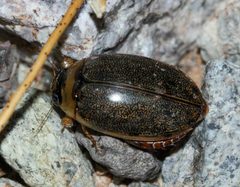
Thermonectus sibleyi is a of diving in the Dytiscidae, first described by Goodhue-McWilliams in 1981. It is native to western Mexico and southern Arizona, United States. The species is relatively small for the , reaching 11.4–13.8 mm in length, and is distinguished by its light, speckled coloration.


Pronunciation
How to pronounce Thermonectus sibleyi: //ˌθɜːrmoʊˈnɛktəs ˈsɪbliːaɪ//
These audio files are automatically generated. While they are not always 100% accurate, they are a good starting point.
Identification
Distinguished from other Thermonectus by its relatively small size (11.4–13.8 mm versus larger such as T. marmoratus) and light, speckled color pattern. The combination of small stature and pale speckled appearance separates it from other members of the in its range.
Images
Appearance
Small diving with a total length of 11.4 to 13.8 mm. Overall coloration is light with a speckled pattern. As a member of the Thermonectus, it possesses the typical streamlined, oval body form adapted for aquatic life.
Habitat
Aquatic environments in arid and semi-arid regions of western North America. Specific microhabitat preferences within water bodies have not been documented.
Distribution
Western Mexico and southern Arizona, United States. The occupies a restricted range at the interface of the Sonoran Desert and adjacent regions.
Behavior
As a diving , it is adapted for underwater locomotion and respiration. Specific behavioral observations for this have not been published.
Ecological Role
As a member of the Dytiscidae, it likely functions as an aquatic in freshwater , though its specific ecological role has not been studied.
Similar Taxa
- Thermonectus marmoratusOverlaps in range (Arizona) but is larger and has a marbled rather than speckled color pattern
- Other Thermonectus speciesT. sibleyi is distinguished by its smaller size and lighter, speckled coloration compared to most
More Details
Taxonomic history
Described by Goodhue-McWilliams in 1981, making it a relatively recently recognized within the Thermonectus