
Badister
Clairville, 1806
Species Guides
13- Badister elegans
- Badister ferrugineus
- Badister flavipes
- Badister grandiceps
- Badister maculatus
- Badister micans(Trembling Harp Ground Beetle)
- Badister neopulchellus(Red-black Spotted Beetle)
- Badister notatus
- Badister obtusus(Short Spotted Beetle)
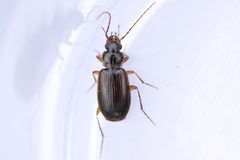
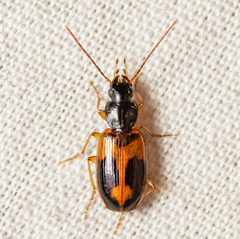
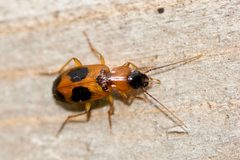
Badister is a of small ground beetles in the Carabidae, comprising approximately 54 distributed across North Africa, the Near East, and the Holarctic. Members of this genus are characterized by asymmetric adapted for shell-breaking on gastropods. The genus is classified within the tribe Licinini, a group widely associated with snail-eating . Badister species occupy wetland and riparian , with documented activity in wet grasslands, lakeshores, and riverbanks.
Pronunciation
How to pronounce Badister: /ˈbædɪstər/
These audio files are automatically generated. While they are not always 100% accurate, they are a good starting point.
Identification
Badister can be distinguished from other carabid by their strikingly asymmetric : the left mandible is truncated with a depressed inner surface, while the right mandible possesses a notch and semicircular blade (terebral tooth). These mandibular modifications are specialized for breaking dextral snail shells. The small body size (approximately 6.5–7.5 mm in studied species) and placement within Licinini further assist identification. Species-level differentiation requires examination of genitalia and other fine morphological characters.
Images
Habitat
Wetland and riparian environments including wet grasslands along paddy fields, lakeshores, and riverbanks. Irish are concentrated in southern and western regions, with northern limits in midland counties.
Distribution
Native to North Africa, the Near East, and the Holarctic including Europe. Documented in Ireland (south and west, north to midland counties), Britain, Scandinavia, Japan, Taiwan, and Russia.
Diet
Live snails (Gastropoda). Badister pictus has been observed to successfully prey on small terrestrial and aquatic snails with dextral shells. success decreases with increasing shell size, shell thickness, and presence of an .
Behavior
attack live snails using asymmetric to break shells: the left mandible is placed against the external shell wall, the right mandible against the internal wall. Beetles consistently attack the outer lip of dextral shells first, breaking along the part of toward the apex. Individuals abandon snails that are too large, have thick shells, or possess .
Ecological Role
Shell-breaking exerting on the evolution of defensive shell structures in small-sized snails.
Similar Taxa
- Other Licinini generaShare general snail-feeding association but lack the extreme mandibular asymmetry and specialized shell-breaking of Badister.
- DyschiriusSmall carabids sometimes confused with Badister, but possess symmetric and different ecological preferences.
More Details
Mandible Specialization
The asymmetric of Badister represent a derived within Carabidae for accessing molluscan prey. The right mandible's terebral tooth and notch, combined with the truncated left mandible, create a lever system effective against dextral shells but less successful against sinistral or heavily armored .
Predation Limitations
Laboratory studies demonstrate that 41.9% of provided snails could not be consumed by B. pictus , indicating significant constraints on prey acquisition despite morphological specialization.