
Trichotichnus
A.Morawitz, 1863
Species Guides
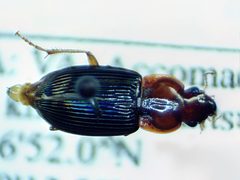
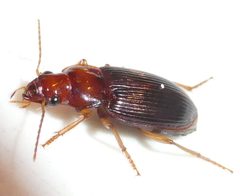
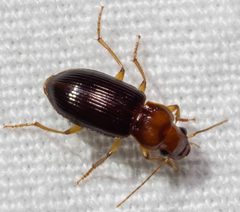
4Trichotichnus is a of ground beetles in the Carabidae, subtribe Harpalina, comprising more than 260 worldwide. The genus is divided into multiple subgenera including Trichotichnus s. str., Bottchrus, Iridessus, Amaroschesis, Harpaloxenus, and Parairidessus. Species occur primarily across the Palaearctic region, with significant diversity in the Himalayas, East Asia, and Korea. Many species exhibit wing , including brachypterous (short-winged, flightless) forms that are geographically restricted.
Pronunciation
How to pronounce Trichotichnus: /trɪˈkɒtɪknəs/
These audio files are automatically generated. While they are not always 100% accurate, they are a good starting point.
Identification
Identification to level requires examination of male genitalia, particularly the lobe of the . Subgenera are distinguished by combinations of morphological characters including wing development, body proportions, and genitalic structure. Brachypterous species in the subgenus Bottchrus are grouped informally based on degree of hindwing reduction and aedeagus configuration. Species in the nominotypical subgenus often require comparison of tarsal proportions, pronotal shape, and elytral microsculpture.
Images
Habitat
Found in mountainous regions, particularly in the Himalayas and adjacent areas. Specific include leaf litter in forested areas, as documented for Korean . Elevational range spans from mid-elevation valleys to high mountain slopes, with many showing narrow geographic restriction due to limited ability.
Distribution
Primarily Palaearctic distribution. Documented from: Nepal (multiple districts including Baglung, Kaski, Solu Khumbu, Bhojpur, Dolakha, Lamjung, Nuwakot, Gorkha, Sindhupalchok, Taplejung), India (West Sikkim), China (Yunnan, Sichuan, Shaanxi), North Vietnam, North West Laos, and Korea. GBIF records indicate presence in Sweden and Vermont, USA. The shows highest in Himalayan and East Asian montane regions.
Behavior
Many exhibit wing dimorphism, including brachypterous (flightless) and (fully winged) forms. Sex-linked wing dimorphism has been documented in T. laevicollis and T. nitens. Brachyptery correlates with restricted geographic distributions and localized . Some species show dimorphic populations with both winged and short-winged individuals co-occurring.
Similar Taxa
- HarpalusBoth in subtribe Harpalina; Trichotichnus distinguished by more slender body form, different pronotal structure, and male genitalia
- OphonusSimilar ground beetle habitus; Trichotichnus separated by tarsal structure and characteristics
More Details
Taxonomic Structure
The contains six recognized subgenera: Trichotichnus s. str. (nominotypical), Bottchrus, Iridessus, Amaroschesis, Harpaloxenus, and Parairidessus. Recent taxonomic revisions have described numerous new , particularly from the Himalayan region and China, with 15 new species described from Bottchrus alone in 2017.
Wing Polymorphism
Wing reduction is a major evolutionary theme in the . The subgenus Bottchrus is characterized by brachypterous , while other subgenera contain both fully winged and dimorphic species. This has significant biogeographic consequences, promoting in montane .
Sources and further reading
- BugGuide
- Wikipedia
- GBIF taxonomy match
- iNaturalist taxon
- NCBI Taxonomy
- Catalogue of Life
- Taxonomic and faunistic notes on the genus Trichotichnus from Korea (Coleoptera, Carabidae, Harpalinae, Harpalini)
- Brachypterous ground beetles of the Trichotichnus subgenus Bottchrus Jedlička (Coleoptera, Carabidae) from the Himalaya, with description of fifteen new species
- Distribution, the special case of sex-linked wing dimorphism and phenology of the life cycle in Trichotichnus laevicollis and T. nitens
- Distribution, the special case of sex-linked wing dimorphism and phenology of the life cycle in Trichotichnus laevicollis and T. nitens (Coleoptera, Carabidae)
- Distribution, the special case of sex-linked wing dimorphism and phenology of the life cycle in Trichotichnus laevicollis and T. nitens (Coleoptera, Carabidae)
- New data on carabid beetles of Trichotichnus s. str. (Coleoptera: Carabidae) of Yunnan (China) and adjacent areas, with description of six new species and two new subspecies