
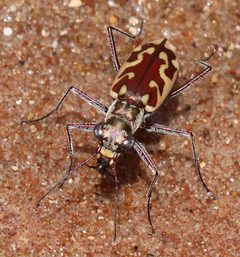
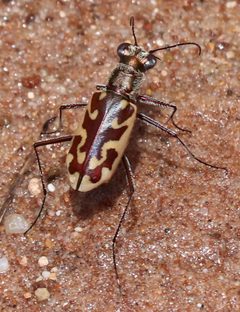
Ellipsoptera macra
(LeConte, 1856)
Sandy Stream Tiger Beetle
Species Guides
1- Ellipsoptera macra fluviatilis(Panhandle Tiger Beetle)
Ellipsoptera macra, commonly known as the sandy stream tiger , is a of tiger beetle in the . The species occurs in North America, particularly along sandy riverbanks and stream edges. It is closely related to Ellipsoptera cuprascens (coppery tiger beetle), with which it shares preferences. The species is notable for being more readily collected using blacklight traps at night than through daytime searching.
Pronunciation
How to pronounce Ellipsoptera macra: /ɛˌlɪpsəˈtɛrə ˈmækrə/
These audio files are automatically generated. While they are not always 100% accurate, they are a good starting point.
Identification
Best distinguished from the similar Ellipsoptera cuprascens by examining female specimens: E. macra has an acute (pointed) sutural apex of the , while E. cuprascens has a rounded apex. Males are more difficult to separate, but E. macra typically shows less shiny elytra with smaller, shallower punctures. Some references note a more recurved lower portion of the humeral lunule and greener coloration in E. macra, though these characters are not always reliable.
Images
Habitat
Sandy along large rivers and streams, specifically near the water's edge. Occupies similar riparian sandy environments as E. cuprascens.
Distribution
North America. Recorded from localities along the Missouri River in northwestern Missouri and presumably occurs elsewhere within the Mississippi-Missouri river system. The three (E. m. ampliata, E. m. fluviatilis, E. m. macra) suggest broader distribution across North American river systems.
Seasonality
have been collected from late June to mid-July. Blacklighting at night appears more productive than daytime collecting during this period.
Behavior
are attracted to ultraviolet blacklights at night, often arriving at light sheets in numbers within 15 minutes of setup. When disturbed or released after capture, adults fly quickly and readily. Daytime appear less numerous than nighttime activity would suggest.
Human Relevance
Subject of targeted survey efforts by entomologists; its collection in Missouri completed a 24- inventory of the state's tiger beetles. Blacklighting techniques developed for this species may aid in detecting elsewhere.
Similar Taxa
- Ellipsoptera cuprascensShares riparian sandy and general appearance; distinguished by shinier with larger, deeper punctures, and in females by rounded (not acute) sutural apex of elytra
More Details
Blacklighting effectiveness
Unlike most tiger beetles, which are , E. macra is notably more abundant at blacklights at night than during daytime searches. This behavioral difference may explain why the was difficult to detect in Missouri despite suitable being present.
Subspecies
Three recognized: E. m. macra (nominate, LeConte 1856), E. m. ampliata (Vaurie 1951), and E. m. fluviatilis (Vaurie 1951). Geographic boundaries and distinguishing characters of subspecies not detailed in available sources.