
Cryptocercus punctulatus
Scudder, 1862
brown-hooded cockroach, woodroach, wingless wood roach, eastern wood-eating cockroach
Cryptocercus punctulatus is a wingless, wood-feeding to montane forests of the eastern United States. It is one of the few subsocial cockroach , exhibiting extended biparental care of offspring over multiple years. The species harbors obligate cellulolytic flagellate in its , transferred to through proctodeal by parents. Its —xylophagy, social , and gut —makes it a key model for understanding the evolutionary origins of eusociality.
Pronunciation
How to pronounce Cryptocercus punctulatus: //ˌkrɪptoʊˈsɜrkəs pʌŋkˈtjʊleɪtəs//
These audio files are automatically generated. While they are not always 100% accurate, they are a good starting point.
Identification
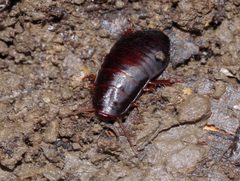
Wingless with brown to black coloration, 23–30 mm in length. Distinguished from other Cryptocercus by geographic range (eastern Appalachians versus western North America for ). Within its range, four cryptic karyotypes exist (2n=37, 39, 43, 45) that are phenotypically identical; identification to species level relies on geography rather than . Differs from by -like body plan, lack of differentiation, and absence of /soldier castes.
Images
Habitat
Inhabits moist, decaying fallen logs in temperate montane forests, predominantly above 400 meters elevation. Occupies both deciduous and coniferous wood, with galleries excavated in softer, more decayed portions of logs. Requires older forest stands with established dead wood; absent from regenerating areas lacking fallen trees.
Distribution
to the Appalachian Mountains and adjacent regions of the eastern United States. Documented in western Virginia, West Virginia, Pennsylvania, and recently reported from monadnock outcrops in the Piedmont of North Carolina. Distribution limited by distance between suitable logs; no capability. Historical range shifts documented in response to glacial and interglacial periods.
Diet
; consumes decaying wood. Digestion dependent on obligate , including hypermastigote flagellates (Trichonympha) and bacteria, which enable cellulose breakdown.
Life Cycle
with extended development. form monogamous pairs and typically produce one reproductive episode with 1–4 (~73 mean total). Eggs incubate approximately one year before hatching. Nymphs hatch altricial: eyeless, with thin pale , and lacking cellulolytic . Require 5–6 years to reach reproductive maturity. Extended parental care lasts 3+ years, including gallery excavation, nest , defense, and trophallactic feeding of young.
Behavior
Subsocial with biparental care. groups occupy distinct gallery systems within logs; intruders from other families elicit alarm and fighting responses. Proctodeal —transfer of fluids between individuals—serves both nutrition and of essential gut to offspring. and offspring remain together in natal galleries for multiple years.
Ecological Role
Primary decomposer of dead wood in montane forest . Excavation of galleries and consumption of decaying logs accelerates wood decomposition and nutrient cycling, returning carbon and nitrogen to forest soils.
Human Relevance
Scientific model organism for studying evolution of eusociality, , and lignocellulose digestion. Considered the best living representative of the ancestral state of . No known economic importance; restricted to undisturbed forest with minimal human contact.
Similar Taxa
- Cryptocercus darwini in western North America; distribution prevents overlap with C. punctulatus
- Cryptocercus garciai in western North America; distribution prevents overlap with C. punctulatus
- Cryptocercus wrighti in western North America; distribution prevents overlap with C. punctulatus
- Termites (Isoptera/Termitidae)Convergent xylophagy and gut , but possess differentiation, , and soldiers absent in Cryptocercus
Sources and further reading
- BugGuide
- Wikipedia
- GBIF taxonomy match
- iNaturalist taxon
- NCBI Taxonomy
- Pentatomidae | Beetles In The Bush | Page 2
- In a Cannibalistic Society, It’s Not About Survival—It’s All About Recycling
- Cryptocercus punctulatus (Dictyoptera: Cryptocercidae) from Monadnocks in the Piedmont of North Carolina
- Initial reproductive investment and parental body size in Cryptocercus punctulatus (Dictyoptera: Cryptocercidae)
- Reproduction in the Woodroach Cryptocercus punctulatus Scudder (Dictyoptera: Cryptocercidae): Mating, Oviposition, and Hatch
- Distribution of Karyotypes of the Cryptocercus punctulatus Species Complex (Blattodea: Cryptocercidae) in Great Smoky Mountains National Park
- The life cycle ofAdelina cryptocercisp.nov., a coccidian parasite of the roachCryptocercus punctulatus
- Colony composition, protozoan transfer and some life history characteristics of the woodroach Cryptocercus punctulatus Scudder (Dictyoptera: Cryptocercidae)
- Reference gene selection for transcriptional profiling in Cryptocercus punctulatus, an evolutionary link between Isoptera and Blattodea
- On the Social Organisation, Alarm and Fighting in the Primitive Cockroach Cryptocercus punctulatus Scudder
- Morphology, Phylogeny, and Diversity of Trichonympha (Parabasalia: Hypermastigida) of the Wood‐Feeding Cockroach Cryptocercus punctulatus
- Genetic insights into family group co-occurrence in Cryptocercus punctulatus , a sub-social woodroach from the southern Appalachian Mountains
- Disentangling Gut Bacterial Community Patterns in Cryptocercus punctulatus and Comparing Their Metagenomes with Other Xylophagous Dyctioptera Insects.