
Chorisoneura texensis
Saussure & Zehntner, 1893
small Texas cockroach, Small Yellow Texas Cockroach
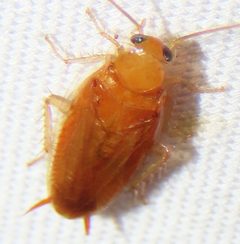
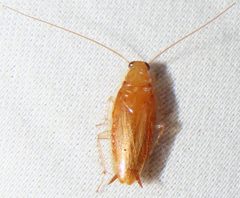
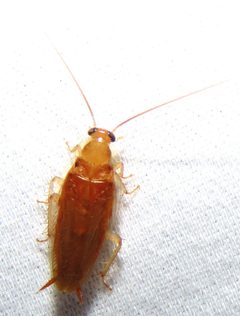
Chorisoneura texensis is a small native to the Southeastern United States. It belongs to the Ectobiidae, a group often referred to as wood cockroaches or forest cockroaches. The species is commonly encountered in outdoor environments and is not considered a significant household pest. It is distinguished from other regional cockroaches by its small size and coloration.
Pronunciation
How to pronounce Chorisoneura texensis: /ˌkɔrɪsoʊˈnʊərə tɛkˈsɛnsɪs/
These audio files are automatically generated. While they are not always 100% accurate, they are a good starting point.
Identification
Distinguished from other small in the southeastern United States by its yellowish coloration and association with outdoor . Smaller than Blattella germanica (German cockroach) and Periplaneta . Differs from Parcoblatta species (wood cockroaches) in coloration and likely habitat preferences. The combination of small size, yellowish-brown color, and southeastern U.S. distribution aids identification.
Images
Appearance
A small with yellowish to light brown coloration. are diminutive relative to common household pest such as the German cockroach or American cockroach. The body is flattened and oval, typical of the order Blattodea. Wings are present and functional in adults.
Habitat
Native to forested and natural outdoor environments in the Southeastern United States. Associated with leaf litter, decaying wood, and other ground-level organic debris. Not adapted to sustained indoor survival.
Distribution
Southeastern United States. Documented from Florida and broader North American range. The specific epithet 'texensis' is potentially misleading; the appears more concentrated in the Southeast rather than Texas specifically.
Seasonality
Activity patterns not well documented in available sources. Likely active year-round in warm climates, with increased surface activity during warmer, humid periods typical of subtropical and temperate .
Behavior
, as typical for . Rapid movement when disturbed. Capable of in .
Ecological Role
Contributes to decomposition of organic matter in forest floor . Serves as prey for various and vertebrate .
Human Relevance
Not considered a significant pest . Lacks the domestic tendencies of Blattella germanica or Periplaneta americana. Occasional indoor encounters are likely incidental invaders from adjacent outdoor rather than established .
Similar Taxa
- Blattella germanicaGerman cockroach is larger, more uniformly tan to brown, and strongly associated with indoor human environments; C. texensis is smaller, yellower, and outdoor-dwelling
- Parcoblatta speciesWood cockroaches share outdoor forest but differ in coloration (often darker) and distribution patterns; some Parcoblatta show stronger attraction to lights
- Periplaneta speciesAmerican and related are substantially larger, darker, and more robust; some are peridomestic pests unlike the non-pest status of C. texensis
More Details
Family Classification Note
Sources differ on placement: iNaturalist lists Pseudophyllodromiidae, while Wikipedia and GBIF list Ectobiidae. Pseudophyllodromiidae is sometimes treated as a (Pseudophyllodromiinae) within Ectobiidae. The taxonomic relationship between these groups remains under study.
Common Name Discrepancy
Wikipedia uses 'small Texas ' while iNaturalist uses 'Small Yellow Texas Cockroach'; the 'Yellow' descriptor reflects the ' coloration and aids differentiation from other 'Texas' named species.