
Panchlora nivea
(Linnaeus, 1758)
Cuban cockroach, green banana cockroach, banana cockroach
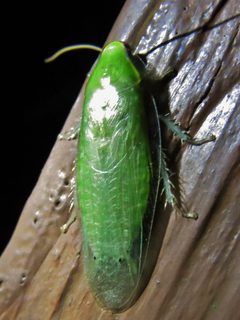
Panchlora nivea is a small, bright green native to Cuba and the Caribbean, now established along the Gulf Coast of the United States from Florida to Texas. Unlike most cockroach , it is primarily an outdoor insect rarely found indoors and is not considered a pest. It has become popular in the pet trade due to its attractive coloration and non- habits.

Pronunciation
How to pronounce Panchlora nivea: //ˈpænˌklɔːrə ˈnɪviə//
These audio files are automatically generated. While they are not always 100% accurate, they are a good starting point.
Identification
Distinguished from other by its bright green coloration and yellow lateral stripe. Most other cockroach in its range are brown, tan, or black. The small size, fully developed wings in both sexes, and strong capability further separate it from larger pest species like Periplaneta americana. Nymphs can be confused with other small dark cockroaches but are identified by context and location.
Images
Appearance
are pale green to yellowish-green with a distinct yellow line running along each side. Females reach 24 mm in length; males are smaller at 12–15 mm. Both sexes are fully winged and are strong fliers. Nymphs are brown or black and are burrowers. The () is curved, 3–4 mm long, with visible indentations marking positions.
Habitat
Primarily an outdoor found in shrubbery, trees, and plants. Nymphs occur under logs and other ground debris. Rarely enters buildings. Strongly attracted to lights, both indoor and outdoor. in activity pattern.
Distribution
Native to Cuba and the Caribbean. Introduced to the United States along the Gulf Coast from Florida to Texas; recorded as far north as South Carolina. Introduced established through Caribbean fruit shipments.
Life Cycle
Reproduces via internal retention; females carry the internally until hatching. Ootheca contains 28–60 (mean 46). At 24°C, eggs hatch in approximately 48 days. Male nymphs mature in about 144 days; female nymphs mature in about 181 days.
Behavior
. Strong fliers. frequently attracted to artificial lights. Not known to establish indoor .
Human Relevance
Not considered a pest due to outdoor habits and rarity of indoor occurrence. Popular in the pet trade as an attractive, non-. Used as feeder insects for other pets.
Similar Taxa
- Periplaneta americanaMuch larger (up to 53 mm), reddish-brown, not green, and a significant indoor pest—easily distinguished by color and size.
- Blattella germanicaSmaller (13–16 mm), tan to light brown, common indoor pest—lacks green coloration and yellow stripe.
More Details
Invasion history
Entered the United States through Caribbean fruit shipments, establishing in Gulf Coast states.
Pet trade popularity
Valued in captivity for its striking green color and because it does not infest homes, unlike common pest .