
Nauphoeta cinerea
(Olivier, 1789)
Cinereous Cockroach, Speckled Cockroach, Lobster Cockroach
Nauphoeta cinerea is a circumtropical native to northeastern Africa that has achieved global distribution through human association. Commonly known as the cinereous, speckled, or lobster cockroach, this species is frequently used as a laboratory model for studying social , neurobiology, and reproductive physiology. Males establish strict that determine territorial rights and mating access, with social status mediated through pheromonal communication and acoustic stridulation. The species has been documented harboring endosymbionts of the F clade, which may provide nutritional benefits.
Pronunciation
How to pronounce Nauphoeta cinerea: /nɔːˈfuː.tə sɪˈnɪr.iː.ə/
These audio files are automatically generated. While they are not always 100% accurate, they are a good starting point.
Identification
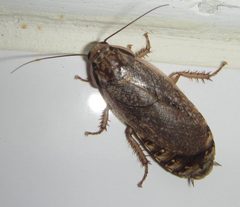
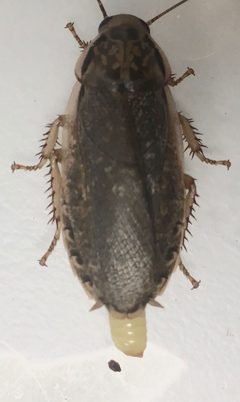
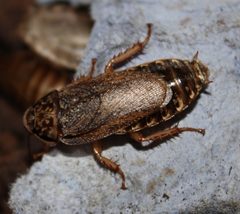
Medium-sized with distinctive speckled or mottled coloration; body shape somewhat flattened and elongated compared to domestic pest . Males possess specialized structures for stridulatory sound production during courtship. The species lacks the pronounced wings seen in many flying cockroaches. Can be distinguished from common domestic pests (Blattella germanica, Periplaneta americana) by its more robust build and speckled pattern; from other Blaberidae by its smaller size and lack of extreme in some related .
Images
Habitat
Tropical and subtropical environments; strongly associated with human-modified including buildings, greenhouses, and stored food facilities. In naturalized , found in decaying organic matter, leaf litter, and beneath bark or stones. Laboratory studies indicate adaptability to varied conditions but preference for sheltered, humid microhabitats with access to food resources.
Distribution
Native to northeastern Africa; now circumtropical in distribution due to human-mediated . Established recorded across the Caribbean, Middle America, North America, Europe and Northern Asia (excluding China), and extensively throughout Brazil (all 27 states). Present in greenhouse and laboratory settings worldwide.
Diet
; consumes decaying plant matter, organic debris, and opportunistically available food sources. Laboratory maintained on varied diets including commercial feed.
Life Cycle
with () production; females give birth to nymphs after internal incubation. Development includes multiple nymphal instars before adulthood. In laboratory conditions, females may exhibit post-partum receptivity following a refractory period controlled by nervous inhibition of mating .
Behavior
Males form stable, long-term that determine territorial rights. Only alpha (top-) males hold absolute territories; gamma (bottom-ranking) males lack territorial rights except under crowded conditions. Males produce stridulatory sounds by rubbing specialized structures together during courtship. Competition for territory centers around female groups, with males establishing residence near aggregated females during daytime. When disturbed, individuals may exhibit (feigned death). Female grouping is pronounced; once females join a group, they remain except for brief excursions or parturition. Social structure -dependent: at low density, territorial/hierarchical organization prevails; at high density, males clump together with only one food-territory holder, and aggression in middle-ranking males is inhibited.
Ecological Role
contributing to decomposition of organic matter. As a laboratory model organism, serves as research subject for studies on social , neurobiology, and insect-microbe interactions including .
Human Relevance
Widely used as a laboratory model organism for behavioral, physiological, and toxicological research. Occasionally a minor stored-product or greenhouse pest in tropical regions. Documented of F-clade endosymbionts, with potential implications for future strategies targeting nutritional dependencies. Used as a model for diabetes and metabolic stress research.
Similar Taxa
- Blaptica dubiaSimilar size and preference in laboratory settings; distinguished by more uniform coloration and different male social structure.
- Gromphadorhina portentosaBoth in Blaberidae and used as laboratory pets; distinguished by larger size, pronounced with horns in males, and hissing rather than stridulatory sound production.
- Blattella germanicaOverlaps in human-associated ; distinguished by smaller size, different body proportions, absence of complex male , and lack of stridulation.
Sources and further reading
- BugGuide
- GBIF taxonomy match
- iNaturalist taxon
- NCBI Taxonomy
- Wolbachia in Cockroaches: A New Paradigm for Urban Pest Management?
- The Mechanism Matters: How Leaf Removal Kills a Common Grape Pest
- Bug Eric: Spider Sunday: Starbellied Orbweaver
- Correlates of subordinate behaviour in the cockroach, Nauphoeta cinerea
- Stridulation by the cockroach Nauphoeta cinerea during courtship behaviour
- Sexual Selection and the Genetics of Pheromonally Mediated Social Behavior in Nauphoeta cinerea (Dictyoptera: Blaberidae)
- Entomotoxic activity of Eragrostis plana Nees extract on the central and peripheral nervous systems of cockroaches Nauphoeta cinerea Olivier Atividade entomotóxica do extrato de Eragrostis plana Nees sobre o sistema nervoso central e periférico de baratas Nauphoeta cinerea Olivier
- Hierarchy and Its Relation To Territory in the Cockroach Nauphoeta Cinerea
- Fine structure of axons associated with the salivary apparatus of the cockroach, Nauphoeta cinerea
- Hypersexual Activity Induced in Females of the Cockroach Nauphoeta cinerea
- Territoriality and the Influence of Females On the Spacing of Males in the Cockroach, Nauphoeta Cinerea
- The inheritance of social dominance, mating behaviour and attractiveness to mates in male Nauphoeta cinerea
- Informational Analysis of Agonistic Behaviour and Dominance Hierarchy Formation in a Cockroach, Nauphoeta Cinerea
- Pheromone production and mating behaviour by allatectomized males of the cockroach, Nauphoeta cinerea
- Trypsin activity associated with reproductive development in the cockroach, Nauphoeta cinerea (Blattaria)
- Integrative biochemical and computational analysis of leflunomide-induced redox alterations in Nauphoeta cinerea.
- Fermented Tamarindus indica Seeds Mitigate Metabolic and Oxidative Stress in a Nauphoeta cinerea Model of STZ‐Induced Diabetes: Implications for Alzheimer’s disease.