
Nauphoeta
Burmeister, 1838
speckled cockroach, lobster cockroach, cinereous cockroach
Species Guides
1- Nauphoeta cinerea(Cinereous Cockroach)
Nauphoeta is a of in the Blaberidae, containing the single Nauphoeta cinerea. The genus is notable for its well-studied social , including male territoriality and . Nauphoeta cinerea has become a widely used laboratory model organism for behavioral, physiological, and toxicological research, and has achieved a circumtropical distribution through human-mediated .
Pronunciation
How to pronounce Nauphoeta: /naʊˈfiːtə/
These audio files are automatically generated. While they are not always 100% accurate, they are a good starting point.
Identification
The Nauphoeta is represented by a single , N. cinerea, distinguished by its mottled brown coloration, fully developed wings in , and moderate size (up to 30 mm). In laboratory settings, identification is straightforward due to the status of the genus; however, in field conditions where other blaberid co-occur, examination of genitalia or molecular methods may be necessary for definitive identification.
Images
Appearance
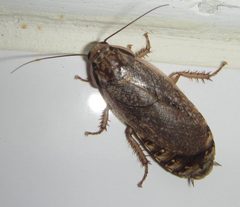
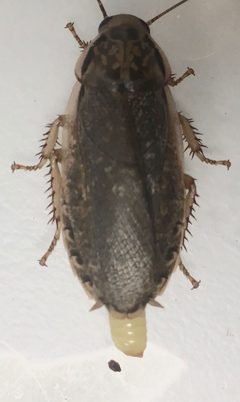
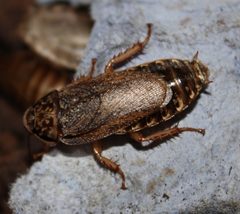
are mottled brown in coloration. Mature individuals are fully winged (). Body length reaches up to 30 mm.
Habitat
Originally native to arid and semi-arid regions of northeastern Africa. In introduced ranges, found in human-associated environments including ships, warehouses, and buildings. Specific microhabitat preferences in natural settings are poorly documented.
Distribution
Native to northeastern Africa (Egypt, Eritrea, Libya, Sudan). Introduced and established across circumtropical regions including Madagascar, Thailand, Philippines, Indonesia, Australia, Hawaii (USA), Mexico, Cuba, Galapagos Islands (Ecuador), and Brazil. Distribution driven primarily by human commerce and stowaway transport on ships.
Diet
, feeding on decaying organic matter and available food resources. Specific dietary composition in natural is not well documented.
Life Cycle
Development from newly hatched nymph to requires approximately 72 days (males, seven ) to 85 days (females, eight molts). Females produce approximately six lifetime, with each containing an average of 33 and incubating for approximately 36 days in the . Young emerge from the ootheca while still carried by the mother, consume their embryonic and the ootheca, and remain with the mother for approximately one hour before dispersing.
Behavior
Males establish and defend territories, with social organization described as territorial-hierarchical. At low , top- (alpha) males hold absolute territorial rights; bottom-ranking (gamma) males lack territories. Males compete for access to female groups, which tend to aggregate on male-occupied territories. Fighting increases in frequency when females are present. Both sexes produce distress calls (stridulation) by rubbing the pronotum against wing at approximately 60 decibels. Males also stridulate during courtship and have been observed stridulating to other males in same-sex interactions. Courtship chirps are combined into sequences lasting up to three minutes.
Ecological Role
Decomposer, contributing to nutrient cycling through consumption of decaying organic matter. As a laboratory model, serves as a food source for captive and small vertebrates.
Human Relevance
Widely used as live food for captive tarantulas, praying mantids, and small lizards. Employed as a laboratory model organism for research in , physiology, toxicology, and neurobiology. Investigated as a potential protein source for human consumption; bread made with 10% N. cinerea flour was reported to have almost imperceptible flavor difference from wheat bread. Harbors endosymbionts, which has prompted research into potential applications.
More Details
Facultative parthenogenesis
N. cinerea can switch from sexual to when isolated from males, though parthenogenetic is significantly reduced: tenfold fewer offspring, slower development, reduced viability, and shorter lifespan.
Wolbachia infection
N. cinerea harbors F-clade endosymbionts, which are relatively uncommon among (found in only 4 of 16 screened). The Wolbachia strain may provide nutritional benefits including biotin synthesis.
Social dominance inheritance
Social dominance, mating , and attractiveness to mates show heritable components in males, with genetic variation contributing to behavioral differences.
Body size and longevity
Unlike the negative size-longevity relationship seen in many vertebrates, larger N. cinerea individuals exhibit increased longevity, with body mass, length, and pronotum width all positively correlated with lifespan.
Sources and further reading
- BugGuide
- Wikipedia
- GBIF taxonomy match
- iNaturalist taxon
- NCBI Taxonomy
- Catalogue of Life
- Wolbachia in Cockroaches: A New Paradigm for Urban Pest Management?
- cockroaches - Entomology Today
- Correlates of subordinate behaviour in the cockroach, Nauphoeta cinerea
- Sexual Selection and the Genetics of Pheromonally Mediated Social Behavior in Nauphoeta cinerea (Dictyoptera: Blaberidae)
- Entomotoxic activity of Eragrostis plana Nees extract on the central and peripheral nervous systems of cockroaches Nauphoeta cinerea Olivier Atividade entomotóxica do extrato de Eragrostis plana Nees sobre o sistema nervoso central e periférico de baratas Nauphoeta cinerea Olivier
- Hierarchy and Its Relation To Territory in the Cockroach Nauphoeta Cinerea
- Size Matters: Body Size is Correlated with Longevity in Speckled Cockroaches (Nauphoeta cineria)
- Fine structure of axons associated with the salivary apparatus of the cockroach, Nauphoeta cinerea
- Territoriality and the Influence of Females On the Spacing of Males in the Cockroach, Nauphoeta Cinerea
- Hypersexual Activity Induced in Females of the Cockroach Nauphoeta cinerea
- Pheromone production and mating behaviour by allatectomized males of the cockroach, Nauphoeta cinerea
- Trypsin activity associated with reproductive development in the cockroach, Nauphoeta cinerea (Blattaria)
- The inheritance of social dominance, mating behaviour and attractiveness to mates in male Nauphoeta cinerea
- Informational Analysis of Agonistic Behaviour and Dominance Hierarchy Formation in a Cockroach, Nauphoeta Cinerea
- Integrative biochemical and computational analysis of leflunomide-induced redox alterations in Nauphoeta cinerea.
- Fermented Tamarindus indica Seeds Mitigate Metabolic and Oxidative Stress in a Nauphoeta cinerea Model of STZ‐Induced Diabetes: Implications for Alzheimer’s disease.