
Allacma fusca
Stebaeva, 1976
Allacma fusca is a large to western Continental Europe and the British Isles. reach approximately 3.5 mm in length and inhabit moist terrestrial environments, particularly among leaf litter in surface soil layers. The species has been studied for its physiological to elevated carbon dioxide levels compared to deeper-soil springtails.
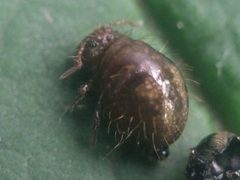

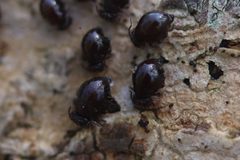
Pronunciation
How to pronounce Allacma fusca: //əˈlæk.mə ˈfʌs.kə//
These audio files are automatically generated. While they are not always 100% accurate, they are a good starting point.
Identification
Distinguished from similar springtails by the combination of large size (3.5 mm), dark brown globular with potential 'snowflake' marking, and specific antennal segment characteristics: unequal setae on third segment and sixteen sub-segments on fourth segment. The mucro —smooth outer edges with saw-edged inner edges—provides additional diagnostic characters. Female specimens can be identified by the unforked fifth abdominal appendage.
Images
Appearance
Large with dark brown globular . Abdomen often bears a distinctive 'snowflake'-like marking, most visible in paler individuals. carries a pair of , two groups of eyespots (composed ), and a pair of small post-antennal organs. Mouthparts are internal. Third antennal segment has setae of unequal length, with some markedly longer than others. Fourth antennal segment divided into sixteen sub-segments. Three thoracic segments each bear one leg; five abdominal segments present. Mucro (terminal structure on dens of fourth abdominal segment) has smooth outer edges and saw-edged inner edges. In females, the appendage on the fifth abdominal segment is unforked.
Habitat
Moist terrestrial environments in surface soil layers, particularly among leaf litter. Found in with sufficient humidity to support surface-dwelling microarthropod .
Distribution
to western areas of Continental Europe and the British Isles. Confirmed present in Belgium (including Brussels-Capital Region and Flemish Region). Distribution records also include São Jorge and São Miguel (Azores, Portugal), though these may represent introductions or require verification.
Ecological Role
Contributes to decomposition processes in surface soil and leaf litter layers. Serves as a representative of surface-dwelling guilds in ecological studies comparing physiological tolerances across soil depth gradients.
Similar Taxa
- Folsomia candidaBoth are springtails, but F. candida is a deeper-soil dweller with markedly different carbon dioxide (survives 10% CO2 for over six weeks versus A. fusca's few hours), indicating divergent physiological adaptations to soil microhabitat stratification.
More Details
Physiological Tolerance
Research has documented that A. fusca can tolerate 10% carbon dioxide levels for only a few hours, contrasting sharply with deeper-soil springtails. This limited reflects its to surface soil layers where CO2 concentrations are lower.