
Folsomia candida
Willem, 1902
Folsomia candida is a small, unpigmented, eyeless that has become one of the most widely used model organisms in soil ecotoxicology. Native to soil environments but now distributed globally through human-mediated , this parthenogenetic species reproduces without males and can be easily maintained in laboratory cultures on simple diets. It has been employed for over 40 years as a standard test organism for assessing and pollutant effects on non-target soil , and has also served as a model for studying cold , , decomposition processes, and soil fungal interactions.
Pronunciation
How to pronounce Folsomia candida: /fɔlˈsoʊ.mi.ə ˈkæn.dɪ.də/
These audio files are automatically generated. While they are not always 100% accurate, they are a good starting point.
Identification
Distinguished from other Folsomia by the specific number of bristles on the furca. The combination of complete lack of eyespots, unpigmented body, and four-segmented separates it from many other collembolan . In laboratory settings, identification is typically confirmed through morphological examination of the furca.
Images
Appearance
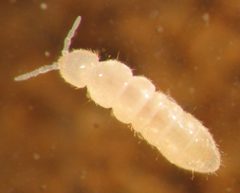
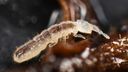
Unpigmented, slender white body reaching up to 3 mm in length. bears four-segmented and post-antennal organs but completely lacks eyespots. First thoracic segment dorsally reduced; three abdominal segments . Fourth abdominal segment ventrally possesses a furca (springing organ) used for jumping. Number of bristles on the furca distinguishes this from .
Habitat
Soil-dwelling microarthropod found in high-organic-content soils, leaf litter in forests, stream verges, farms, mines, and caves. Thrives in moist soil environments with abundant fungal resources. Laboratory cultures maintained on moist plaster of Paris or similar substrates with yeast food source.
Distribution
distribution due to human-mediated as a 'tramp' ; original native range unclear. Established on multiple continents including Europe, North America, and Atlantic islands (Azores: Faial, Flores, Graciosa, São Miguel, Terceira).
Seasonality
and activity occur year-round in stable laboratory conditions. In natural soil environments, seasonal variation in reproductive output has been documented, with reduced reproduction in winter months observed in some .
Diet
Feeds primarily on fungal , including grazing on root mycorrhizae. In laboratory culture, maintained on granulated baker's yeast.
Life Cycle
hatch in approximately one week at 21°C. Juveniles undergo five over three weeks to reach maturity. continue molting throughout life, approximately 45 times total, including lining shedding. Lifespan ranges from 110 to 240 days depending on temperature. Each female lays approximately 1,000 eggs.
Behavior
Exhibits aggregative influenced by previous environmental conditioning. Uses furca for jumping escape response. Tolerates elevated carbon dioxide levels for extended periods, reflecting to deeper soil microhabitats.
Ecological Role
Contributes to soil decomposition through grazing on fungi. May provide beneficial services by feeding on plant-pathogenic and mites. Serves as prey for other soil . Functions as a bioindicator for soil health assessment.
Human Relevance
Primary standard test organism for soil ecotoxicology and risk assessment for over 40 years. Used to evaluate effects of soil pollutants, heavy metals, nanoparticles, and pesticides on non-target soil . Model organism for research on cold , CO2 tolerance, circadian and circaseptan rhythms, decomposition processes, fungal grazing impacts, and aging. Laboratory cultures used as invertebrate food for other organisms.
Similar Taxa
- Other Folsomia speciesDistinguished by furca bristle count; F. candida has specific diagnostic bristle number
- Surface-dwelling springtails (e.g., Allacma fusca)F. candida tolerates much higher CO2 levels for longer periods, reflecting deeper soil
More Details
Laboratory Standardization
ISO 11267 protocol standardizes testing using F. candida for regulatory ecotoxicology. Test validity depends on meeting control reproduction benchmarks; seasonal variation in baseline reproduction can affect test interpretation.
Parthenogenetic Reproduction
All consist exclusively of females reproducing via , eliminating the need for males in culture maintenance and ensuring genetic uniformity within strains.
Sources and further reading
- BugGuide
- Wikipedia
- GBIF taxonomy match
- iNaturalist taxon
- NCBI Taxonomy
- Catalogue of Life
- UC Davis Doctoral Candidate Brendon Boudinot Shares Expertise on Ants | Bug Squad
- Doctoral Candidate Lindsey Mack: Zeroing in on the Yellow Fever Mosquito | Bug Squad
- Congrats to Outstanding UC Davis Doctoral Candidate Alison Blundell | Bug Squad
- Doctoral Candidate Brendon Boudinot to Discuss Evolution of Insects at Exit Seminar | Bug Squad
- UC Davis Doctoral Candidate Brendon Boudinot: Adding to Our Knowledge of Ants | Bug Squad
- Congrats to Mia Lippey and Ziv Lieberman, UC Davis Entomology Doctoral Candidates | Bug Squad
- What causes variability in the Folsomia candida reproduction test?
- FOLSOMIA CANDIDA(COLLEMBOLA): A “Standard” Soil Arthropod
- Soil quality. Inhibition of reproduction of Collembola (Folsomia candida) by soil contaminants
- Soil quality. Inhibition of reproduction of Collembola (Folsomia candida) by soil contaminants
- Soil quality. Inhibition of reproduction of Collembola (Folsomia candida) by soil contaminants
- Assessing the Potential Impacts of Untreated Greywater Irrigation on Select Terrestrial Organisms: Brassica Rapa, Eisenia Andrei, Folsomia Candida
- Assessing the Potential Impacts of Untreated Greywater Irrigation on Select Terrestrial Organisms: Brassica Rapa, Eisenia Andrei, Folsomia Candida
- The effect of DDT on the life history of Folsomia candida
- Seasonal effects on the outcome of reproduction tests with silver nanoparticles, silver nitrate and the Collembola Folsomia candida
- Low concentration effects and different outcome in repeated reproduction tests with silver nanoparticles, silver nitrate and Folsomia candida (Collembola)
- Aggregative behaviour in Folsomia Candida (Collembola : Isotomidae), with respect to previous conditioning