
Deuterosminthurus bicinctus
(Koch, 1840)
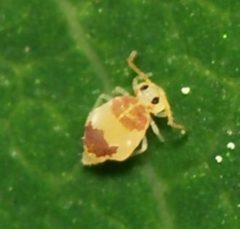
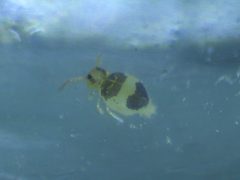
Deuterosminthurus bicinctus is a in the Bourletiellidae, first described by Koch in 1840. It is notable for its elaborate courtship and mating rituals involving transfer, which have been studied in detail. Males perform a complex sequence of including a rhythmic -to-head 'dance' to direct females to deposited spermatophores. The species has been recorded across Europe, the Mediterranean region, Macaronesia, and Australia.
Pronunciation
How to pronounce Deuterosminthurus bicinctus: //ˌdjuːtəroʊˌsmɪnˈθjʊərəs baɪˈsɪŋktəs//
These audio files are automatically generated. While they are not always 100% accurate, they are a good starting point.
Images
Habitat
Leaves of plants. Observations and video recordings have been made on foliage, though the specific host plant has not been identified.
Distribution
Europe; Mediterranean region; Macaronesia; Central Australia; northern and eastern Australia.
Host Associations
- host plant (unspecified species) - Mating observed on leaves, but plant not identified to or species level.
Behavior
Males exhibit elaborate courtship rituals to achieve transfer. The mating sequence includes: (1) preliminary courtship where males recruit partners using , legs, or ; (2) a rigid rhythmic push-and-retreat 'dance' of approximately 180 phases performed head-to-head; (3) male 'free turns' interspersed throughout; (4) spermatophore deposition on the substrate; (5) male stimulation of the female to walk over the spermatophore for uptake by the . Females may consume the spermatophore entirely instead of using it for (observed in 29% of pairs), after which both sexes typically compete for residuals with females usually winning. Female motivation, influenced by hunger and impregnation state, appears critical for male reproductive success.
More Details
Mating system notes
The exhibits indirect sperm transfer via , a characteristic of Collembola, but with unusually elaborate behavioral elaboration. The consumption of spermatophores by females as food rather than sources represents a potential sexual conflict in this system.
Sources and further reading
- BugGuide
- GBIF taxonomy match
- iNaturalist taxon
- NCBI Taxonomy
- Catalogue of Life
- Check List | Blog - Part 4
- Ritual behaviors associated with spermatophore transfer in Deuterosminthurus bicinctus (Collembola: Bourletiellidae)
- Ritual behaviors associated with spermatophore transfer in Deuterosminthurus bicinctus (Collembola: Bourletiellidae)