
Deuterosminthurus
Börner, 1901
Species Guides
4Deuterosminthurus is a of springtails (Collembola: Symphypleona) in the Bourletiellidae, established by Börner in 1901. The genus contains approximately 30 described distributed across multiple continents including Europe, Asia, North America, and Australia. At least one species, Deuterosminthurus bicinctus, has been the subject of detailed behavioral studies documenting complex mating rituals. Some species are associated with specific plants, including documented associations with Genista hispanica.
Pronunciation
How to pronounce Deuterosminthurus: //ˌdjuːtəroʊsmɪnˈθjʊərəs//
These audio files are automatically generated. While they are not always 100% accurate, they are a good starting point.
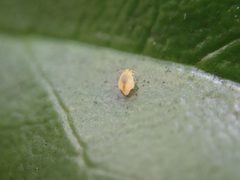
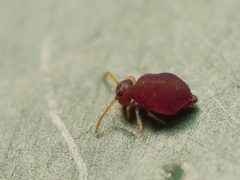
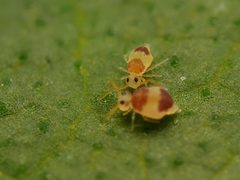
Images
Habitat
have been documented on leaves of plants, specifically Genista hispanica for D. bisetosus. The as a whole likely occupies vegetation-associated microhabitats typical of Bourletiellidae.
Distribution
Recorded from the Iberian Peninsula, Andean region, Antilles and southern Florida, Caribbean mainland, central Australia, and continental Southeast Asia. Individual show more restricted ranges; for example, D. bisetosus is known from distant localities across the Iberian Peninsula, while D. ezoensis occurs in Japan and D. okinawanus in Okinawa.
Host Associations
- Genista hispanica L. - plant Documented for D. bisetosus; found living on this plant for three consecutive years
- Polydiscia deuterosminthurus - Larval instars of this prostigmatid mite attach to D. bisetosus
Behavior
In Deuterosminthurus bicinctus, males perform elaborate ritualized courtship involving: preliminary courtship of variable duration; a push-and-retreat -to-head ritual with approximately 180 rhythmic phases; male free turns; deposition; and stimulation of females to walk over spermatophores for pickup with the . Females consume spermatophores in approximately 29% of observed pairs. Post-mating competition for spermatophore residuals occurs, usually won by females. Males use , legs, or heads to monopolize, stimulate, and direct females. No morphological differences have been found between successful and unsuccessful males; female motivation appears crucial for mating success.
More Details
Species diversity
The contains at least 30 described , with new species continuing to be described (e.g., D. bisetosus described 2003, D. serratus described 2005). Species epithets suggest color pattern variation (bicinctus, caeruleacaudus, luridus, maculatus, pallipes, russatus, sulphureus).
Sources and further reading
- BugGuide
- Wikipedia
- GBIF taxonomy match
- iNaturalist taxon
- NCBI Taxonomy
- Catalogue of Life
- Ritual behaviors associated with spermatophore transfer in Deuterosminthurus bicinctus (Collembola: Bourletiellidae)
- Ritual behaviors associated with spermatophore transfer in Deuterosminthurus bicinctus (Collembola: Bourletiellidae)
- A new species of Polydiscia (Acari, Prostigmata, Tanaupodidae) with reference to its host: a new species of Deuterosminthurus (Collembola, Symphypleona, Bourletiellidae)