
Neelidae
Folsom JW, 1896
Genus Guides
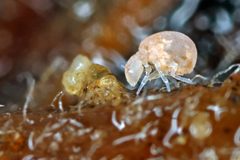
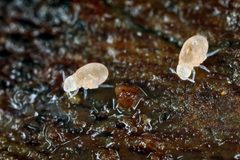
2is a of minute springtails in the order Neelipleona, comprising at least four and more than 30 described . Members average around 500 μm in length and possess globular bodies superficially resembling those of Symphypleona, with relatively long legs and a well-developed furca. Molecular phylogenetic data places Neelidae as a basal group to all other Collembola, despite earlier morphological hypotheses linking them closely to Symphypleona. The family has worldwide distribution with records from Gondwanan regions, caves, and various terrestrial .
Pronunciation
How to pronounce Neelidae: //niːˈlaɪdiː//
These audio files are automatically generated. While they are not always 100% accurate, they are a good starting point.
Identification
can be distinguished from other by their combination of minute size (~500 μm), globular body shape, relatively long legs, and well-developed furca. They superficially resemble Symphypleona in body form but differ in their phylogenetic placement and specific chaetotaxy patterns. within Neelidae are distinguished by features such as chaetotaxy of the , shape of S- on antennomeres, dorsal abdominal chaetotaxy, chaetotaxy of the dens, and patterns of τ-chaetae. of Megalothorax can be identified using the presence or absence of secondary granulation dorsally on the head and , chaetotaxy of the basomedian field of the , and of maxillary outer lobe hairs.
Images
Habitat
Soil-dwelling; some appear restricted to cave environments. Spinaethorax have been documented exclusively from caves in Mexico and Vietnam, suggesting a troglobitic lifestyle for this genus. Megalothorax species show worldwide distribution across various terrestrial including Gondwanan regions. Specific microhabitat preferences for most genera remain poorly documented.
Distribution
Worldwide distribution including: Patagonia (Chile), Tasmania (Australia), South Island (New Zealand), Mexico, Vietnam, Himalayan region of Sikkim (India), Amazon, Andean regions, Antarctic & Subantarctic, Antillean & southern Florida, Arctic & Sub-arctic regions.
Similar Taxa
- SymphypleonaSuperficially similar globular body shape and neosminthuroid setae historically led to hypotheses of close affinity; molecular data now places as basal to all other Collembola, not closely related to Symphypleona
- PoduromorphaBoth contain soil-dwelling springtails, but Poduromorpha typically have more elongated body forms and reduced furca compared to the globular body and well-developed furca of
- EntomobryomorphaBoth are groups, but Entomobryomorpha generally have elongated, scaled bodies distinct from the minute globular form of
More Details
Phylogenetic significance
holds a critical position in Collembola as the sister group to all other springtails based on molecular evidence, contradicting earlier morphological hypotheses that grouped them with Symphypleona.
Taxonomic resources
An open interactive identification key for Megalothorax of the world has been developed to aid in species identification within this .
Sources and further reading
- BugGuide
- Wikipedia
- GBIF taxonomy match
- iNaturalist taxon
- NCBI Taxonomy
- Catalogue of Life
- A New Species of Genus Neelus Folsom, 1896 (Collembola: Neelidae) from Himalayan Region of Sikkim, India
- First record of the genus Spinaethorax Papáč & Palacios-Vargas, 2016 (Collembola, Neelipleona, Neelidae) in Asia, with a new species from a Vietnamese cave.
- A new group of species of the genus Megalothorax (Collembola, Neelidae) with Gondwanan distribution, and introducing an open interactive identification key of Megalothorax species
- The mitochondrial genome of a minute springtail species Megalothorax incertus (Collembola: Neelipleona: Neelidae).