
Diacyclops
Kiefer, 1927
Species Guides
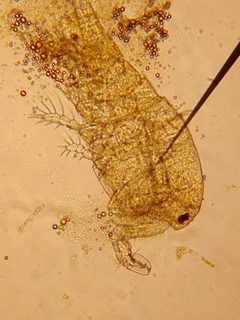
1Diacyclops is a of cyclopoid copepods in the Cyclopidae containing over 120 described . Species occupy diverse aquatic including freshwater lakes, wetlands, rivers, and groundwater systems. Some species are planktonic while others are benthic or stygobiontic. The genus shows broad salinity , with at least one species thriving in brackish conditions up to 5 ppt. Diacyclops species serve as prey for fish and are sensitive indicators of environmental contaminants.
Pronunciation
How to pronounce Diacyclops: /ˌdaɪəˈsaɪklɒps/
These audio files are automatically generated. While they are not always 100% accurate, they are a good starting point.
Identification
within Diacyclops are distinguished by morphological traits of the , fourth swimming leg (P4), and caudal rami. The D. languidoides group contains stygobiont species with reduced and elongated appendages adapted to subterranean . D. cohabitatus can be differentiated from co-occurring D. languidoides group members by specific antennal, P4, and caudal ramus characteristics.
Images
Habitat
include shallow eutrophic lakes, wetlands adjacent to rivers, and groundwater systems. Some are pelagic during cold seasons and undergo in bottom sediments. Stygobiont species inhabit subterranean waters including alluvial plains and karst systems. At least one species tolerates brackish conditions up to nearly 5 ppt salinity.
Distribution
Documented from Central Europe (Germany, Austria), Ukraine (Carpathian Mountains), and North America (Michigan, USA). GBIF records indicate presence in Denmark, Norway, and Sweden. Distribution includes both surface waters and groundwater systems.
Seasonality
D. bicuspidatus exhibits a pelagic phase during cold season with as C4 copepodid stage from June to October/November. One to two pulses occur per year.
Diet
D. bicuspidatus preys on including Caenorhabditis elegans, Plectus aquatilis, and Panagrolaimus , as well as natural nematode .
Life Cycle
Embryonic development in D. bicuspidatus ranges from 13.8 days at 2°C to 1.8 days at 25°C. Interclutch intervals are 1.9–4.0 days. -bearing females carry 50–92 eggs. occurs at the C4 copepodid stage.
Behavior
D. bicuspidatus remain in mud or near the bottom, rarely entering the pelagic zone, likely as avoidance . The shows no apparent local to salinity despite broad physiological .
Ecological Role
Serves as prey for fish in lake . Functions as a planktonic component of cold-season in eutrophic lakes. Preys on , contributing to benthic-pelagic coupling.
Human Relevance
Used as a bioindicator for neonicotinoid ; feeding is more sensitive to thiacloprid (EC50 116–158 μg l−1) than standard daphnid toxicity tests. D. humphreysi has been studied for sensitivity to PFOS in groundwater.
Similar Taxa
- CyclopsBoth are cyclopoid copepods in Cyclopidae; Diacyclops generally smaller with distinct antennal and caudal ramus
- DaphniaCo-occurs in freshwater ; Daphnia are cladocerans with different body plan ( enclosing body, no free ) and typically filter-feed rather than prey on
More Details
Salinity Tolerance
Diacyclops sp. A from Michigan showed no local to salinity, performing better in salt marsh water (up to 5 ppt) than in native freshwater. This suggests distribution may be limited by or suitability rather than physiological constraints.
Taxonomic Complexity
The D. languidoides group contains multiple stygobiont with subtle morphological differences, requiring detailed examination of appendages for accurate identification.
Sources and further reading
- BugGuide
- Wikipedia
- GBIF taxonomy match
- iNaturalist taxon
- NCBI Taxonomy
- Catalogue of Life
- The Diacyclops languidoides - group (Copepoda : Cyclopoida) in Austria, with redescription of Diacyclops cohabitatus Monchenko 1980
- Reproduction and life history of a Central European, planktonic Diacyclops bicuspidatus population
- Figure 4: Experiment 1: Diacyclops sp. A in water from different habitats.
- Figure 5: Experiment 2: D. pulex and Diacyclops sp. A in water from different habitats.
- Figure 7: Experiment 2: Heterocypris sp. A and Diacyclops sp. A in water from different habitats.
- The influence of thiacloprid on the feeding behaviour of the copepod, Diacyclops bicuspidatus, preying on nematodes
- Moderate mortality of groundwater copepods Diacyclops humphreysi after exposure to perfluorooctane sulfonate (PFOS).