
Cyclopidae
Rafinesque, 1815
Genus Guides
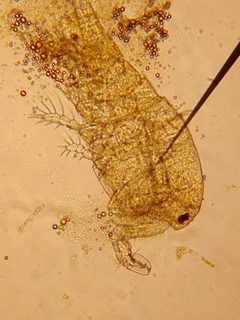
2Cyclopidae is a large of copepod crustaceans containing more than half of the approximately 1,200 in the order Cyclopoida, distributed across over 70 . Members are primarily freshwater organisms, though some species occur in brackish and marine environments. The family exhibits considerable diversity in preference, with species documented from leaf litter in cloud forests, vernal pools, hyporheic zones, and tropical coastal ponds. Cryptic speciation has been demonstrated in some groups, with reproductive isolation occurring among morphologically similar .
Pronunciation
How to pronounce Cyclopidae: //sɪˈklɒpɪˌdiː//
These audio files are automatically generated. While they are not always 100% accurate, they are a good starting point.
Images
Habitat
Freshwater environments including lakes, ponds, streams, and vernal pools; some inhabit leaf litter in cloud forests at high elevations (up to 2000 m), hyporheic zones (subsurface flow beneath stream beds), and brackish coastal ponds. The Vernalis group is specifically associated with vernal pool and temporary freshwater .
Distribution
distribution with records from North America (including Vermont), Central America (Honduras, Nicaragua), South America, Europe (Scandinavia, Denmark), Asia (Kazakhstan, Vietnam, tropical regions), and introduced in the Caribbean (Cayman Islands). The Moraria-group of has a primarily Holarctic distribution with southernmost New World limits in mountainous Honduras and western Nicaragua.
Ecological Role
Some serve as first intermediate for tapeworms, including Triaenophorus crassus, a of fish.
More Details
Cryptic speciation
The Vernalis group exhibits cryptic speciation, with seven reproductive isolates identified through breeding experiments. Most isolates show morphological variation but are not easily distinguishable; one isolate with minimal variation corresponds to C. brevispinosus, previously synonymized with C. vernalis.
Taxonomic diversity
With over 70 and more than 600 , Cyclopidae represents the most species-rich in the order Cyclopoida.
Sources and further reading
- BugGuide
- Wikipedia
- GBIF taxonomy match
- iNaturalist taxon
- NCBI Taxonomy
- Catalogue of Life
- CRYPTIC SPECIATION IN THE VERNALIS GROUP OF CYCLOPIDAE
- Leaf litter copepods from a cloud forest mountain top in Honduras (Copepoda: Cyclopidae, Canthocamptidae)
- First record of Mesocyclops ogunnus Onabamiro, 1957 from Kazakhstan (Crustacea: Cyclopidae)
- A new species of Metacyclops from a hyporheic habitat in North Vietnam (Crustacea, Copepoda, Cyclopidae)