
Sphaeroma
Bosc, 1801
pillbug, roly poly, marine pillbug
Species Guides
2- Sphaeroma papillae(Nassaquatuck Seapill)
- Sphaeroma quadridentatum(sea pill bug)
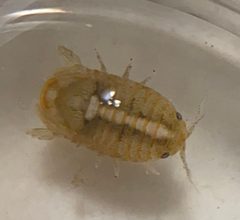
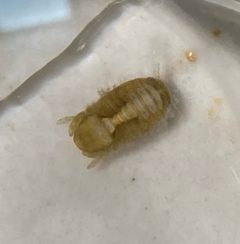
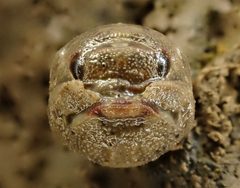
Sphaeroma is a of aquatic isopod crustaceans in the Sphaeromatidae. These small crustaceans are commonly known as marine pillbugs or roly polies, though they are distinct from terrestrial isopods. The genus contains multiple distributed across marine and estuarine environments globally. Some species, such as S. terebrans, are specialized wood-borers in mangrove , while others inhabit rocky intertidal zones or construct burrows in soft sediments. The genus has been subject to recent taxonomic revision, with new species described from the northeastern Pacific and elsewhere.
Pronunciation
How to pronounce Sphaeroma: //sfɛəˈroʊmə//
These audio files are automatically generated. While they are not always 100% accurate, they are a good starting point.
Identification
within Sphaeroma are distinguished by morphological features of the pereopods, pleotelson shape, and tuberculation patterns on pereonites and pleon. For example, S. silvai is distinguished from S. annandalei by a well-extended inferior lobe on pereopod 5 basis, pleotelson shape, and tuberculation patterns. Some species possess distinctive transverse ridges on pereonites. Detailed examination of these structures, often requiring scanning electron microscopy for small specimens, is necessary for accurate species identification.
Images
Habitat
Marine and estuarine environments. Specific occupy distinct : S. terebrans burrows in aerial roots of red mangrove (Rhizophora mangle); S. quoianum constructs dense burrow networks in salt marsh banks; other species inhabit rocky intertidal substrates and harbor areas.
Distribution
Global marine distribution. S. annandalei: northern Indian Ocean from Persian Gulf to Malaysia; S. silvai: South Atlantic Ocean; S. quoianum: southern California salt marshes (non-native, Australian origin); S. quadridentatum: western Atlantic.
Life Cycle
Development varies by . S. quadridentatum: males exhibit terminal while females continue molting until death; mature females alternate reproductive and resting intermolt periods with distinct oostegite morphologies; sizes range 14–67 offspring; offspring require up to five months to reach maturity in laboratory conditions. S. terebrans: juveniles hatch from female's brood pouch and remain in maternal burrow up to 40 days; sub- achieve independence and can construct new burrows within 48 hours.
Behavior
Parental care observed in S. terebrans: offspring remain in maternal burrow for extended period after hatching; most juveniles burrow outward from within natal burrow rather than emigrating; small juveniles separated from mothers require several days to establish burrows. Wood-boring in S. terebrans; efficient burrowing develops late in life. Amplexus in S. quadridentatum precedes reproductive but is not required for ; copulation occurs during the interval between shedding of and .
Ecological Role
S. quoianum increases erosion in salt marsh through dense burrow networks, altering sediment structure, decreasing carbon content, and modifying local by increasing proportions of crustaceans. S. terebrans contributes to mangrove root degradation through wood-boring activity. Some serve as prey items in marine .
Human Relevance
S. quoianum is a non-native of concern in southern California salt marshes, where it contributes to degradation and erosion. S. quadridentatum has been evaluated for potential use in but deemed not cost-effective due to lengthy development time and high mortality. Some discovered in urban environments, including near major ports.
Similar Taxa
- ExosphaeromaBoth belong to Sphaeromatidae and share the -like form; Exosphaeroma was recently revised with new described from the northeastern Pacific, and specimens require careful examination to distinguish from Sphaeroma
- terrestrial isopods (Armadillidium, Porcellio)Share '' or 'roly poly' and superficial body form, but Sphaeroma are aquatic crustaceans with marine/estuarine requirements versus terrestrial in backyard pillbugs
Sources and further reading
- BugGuide
- Wikipedia
- iNaturalist taxon
- NCBI Taxonomy
- Catalogue of Life
- Sphaeromatidae Archives - Entomology Today
- Two New Pillbugs Discovered in Los Angeles
- New species of marine roly poly pillbug discovered near Port of Los Angeles | Blog
- Uncategorized | Blog - Part 14
- A new record of Sphaeroma annandalei Stebbing, 1911 (Crustacea: Isopoda: Sphaeromatidae) from the Persian Gulf, and description of a new related species (Sphaeroma silvai nov. sp.) from the South Atlantic Ocean
- Parental care behavior in the wood-boring isopod Sphaeroma terebrans
- The Distribution of Monomorphic Populations in Sphaeroma Serratum (Isopoda)
- Relationship of Sphaeroma Quoianum to Sediment Characteristics and Invertebrate Community
- Laboratory Observations On the Life History of the Isopod Sphaeroma Quadridentatum Say, 1818