
Paracerceis
Hansen, 1905
Paracerceis is a of marine isopod crustaceans in the Sphaeromatidae, established by Hansen in 1905. The genus comprises at least 13 described distributed across tropical and temperate coastal regions. The best-studied species, Paracerceis sculpta, has become a model organism for research on alternative reproductive tactics and due to its unusual system of three discrete male morphs. Several species have been introduced outside their native ranges, including P. sculpta in Australia and Türkiye.
Pronunciation
How to pronounce Paracerceis: //ˌpærəˈsɜrsiz//
These audio files are automatically generated. While they are not always 100% accurate, they are a good starting point.
Images
Habitat
Marine intertidal zones; some utilize sponges as breeding , including artificial sponges
Distribution
Widespread in tropical and temperate coastal waters; P. sculpta native to the northern Gulf of California, introduced to Australia and the Mediterranean (Türkiye); other recorded from the eastern Pacific, Atlantic, and Indo-Pacific regions
Life Cycle
Females of at least P. sculpta undergo a biphasic reproductive moult that initiates sexual receptivity; following this moult, females experience anatomical changes that restrict mobility and prevent feeding; embryos develop in internal pouches and are released as mancae; gestation duration varies with temperature (13–75 days in P. sculpta); females exhibit obligate , dying after a single reproductive episode
Behavior
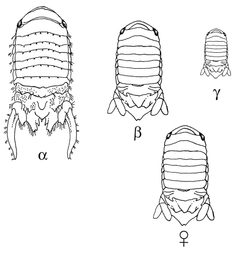
Males of P. sculpta exhibit three discrete morphs (α, β, γ) with alternative reproductive ; α-males are large and defend harems within sponges; β- and γ-males employ sneaking or satellite tactics to achieve copulations; females aggregate in breeding groups within sponge
Human Relevance
P. sculpta has been introduced to multiple regions outside its native range, including Australia and the Mediterranean, and is considered an in these areas; the serves as a model system in behavioral research, particularly for studies of alternative reproductive tactics and
Similar Taxa
- SphaeromaBoth are sphaeromatid isopods with compact, rounded body forms; Paracerceis can be distinguished by specific characters of the pleotelson and uropods, though precise diagnostic features require examination
- ParadellaAnother sphaeromatid with similar general ; Paracerceis generally lack the pronounced sculpturing seen in some Paradella species
More Details
Male polymorphism
P. sculpta is one of the best-documented cases of discrete alternative male morphs in crustaceans, with three genetically determined male types exhibiting distinct morphologies and mating strategies
Reproductive female anatomy
The dramatic anatomical changes in reproductive P. sculpta females, termed 'female ,' have been proposed as a taxonomic character for distinguishing certain sphaeromatid
Sources and further reading
- BugGuide
- Wikipedia
- GBIF taxonomy match
- iNaturalist taxon
- NCBI Taxonomy
- Catalogue of Life
- THE AUSTRALIAN DISTRIBUTION OF THE INTRODUCED SPHAEROMATID ISOPOD, PARACERCEIS SCULPTA
- The use of artificial sponges as breeding habitat by Paracerceis sculpta (Holmes) (Crustacea:Isopoda)
- SIX. The Ecology of Breeding Females and the Evolution of Polygyny In Paracerceis sculpta, A Marine Isopod Crustacean
- The Reproductive Behaviour of α-, β-, and γ-Male Morphs in Paracerceis Sculpta, a Marine Isopod Crustacean
- ALTERNATIVE REPRODUCTIVE BEHAVIORS: THREE DISCRETE MALE MORPHS IN PARACERCEIS SCULPTA, AN INTERTIDAL ISOPOD FROM THE NORTHERN GULF OF CALIFORNIA
- The Effect of Females on Male-Male Competition in the Isopod, Paracerceis Sculpta: A Reaction Norm Approach to Behavioral Plasticity
- Alternative Reproductive Behaviors: Three Discrete Male Morphs in Paracerceis sculpta, an Intertidal Isopod from the Northern Gulf of California
- Changes in female anatomy associated with the reproductive moult in Paracerceis sculpta, a semelparous isopod crustacean
- Review of marine alien isopods in Türkiye with two new records: of Paracerceis sculpta and Paranthura japonica
- Female Sexual Receptivity Associated with Molting and Differences in Copulatory Behavior Among the Three Male Morphs inParacerceis sculpta(Crustacea: Isopoda)
- 87:6538 Alternative reproductive behaviors. Three discrete male morphs in Paracerceis sculpta, an intertidal isopod from the northern Gulf of California