
Androniscus dentiger
Verhoeff, 1908
rosy woodlouse, pink woodlouse
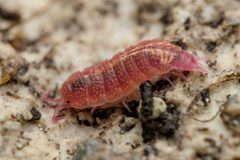
Androniscus dentiger, commonly known as the rosy or pink woodlouse, is a small terrestrial isopod native to western Europe and North Africa. It is notable for its distinctive pink to orange coloration with a yellow stripe, and shows a strong ecological association with calcareous environments. The exhibits geographic variation in use: troglophilic occur in cave systems in southern parts of its range, while surface populations occupy diverse habitats including coastal areas, gardens, and churchyards. In North America, it has been introduced and is known only from greenhouse environments.

Pronunciation
How to pronounce Androniscus dentiger: /ændrɒˈnɪskəs ˈdɛntɪdʒər/
These audio files are automatically generated. While they are not always 100% accurate, they are a good starting point.
Identification
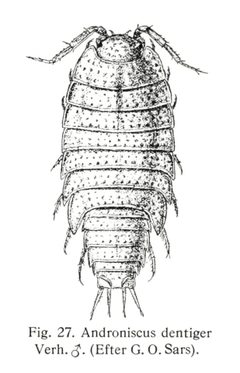
Small size (approximately 6 mm) distinguishes this from many larger woodlice. The pink or orange base color with a yellow mid- stripe that bifurcates toward the is diagnostic. Large relative to body size and a texture are additional distinguishing features. The coloration separates it from the generally grey or brown woodlice common in the same regions.
Images
Habitat
Requires environments with significant lime availability; in the British Isles found in coastal areas, gardens, old quarries, caves, and churchyards. In southern parts of range, primarily occurs in cave systems (troglobitic). In North America, restricted to greenhouses.
Distribution
Native range extends from the British Isles to North Africa. Introduced established in North America (greenhouses only). Records from the Azores (Faial, São Miguel).
Ecological Role
Serves as a decomposer in calcareous . In cave systems, represents part of the in subterranean . in different cave systems are genetically isolated due to lack of between caves.
Human Relevance
Presence in Anglican churchyards reportedly preferred over Catholic ones due to historical use of ox-blood mortar in older Protestant churches, which provides suitable calcareous . Occasionally encountered in gardens. Introduced in North American greenhouses suggest potential as a greenhouse pest or incidental introduction.