
Epicaridea
Latreille, 1825
crustacean isopods
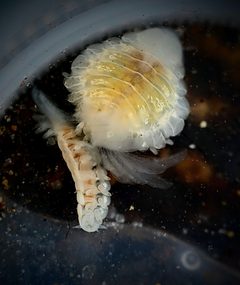
Epicaridea is a suborder of parasitic marine isopods now classified within Cymothoida. Members are obligate of other crustaceans, including ostracods, copepods, barnacles, and malacostracans. The group exhibits extreme , with females typically becoming asymmetrical and losing segmentation while males remain small and morphologically distinct. Development proceeds through regressive involving two or three larval stages, including the distinctive cryptoniscus stage. Approximately 704 have been described globally, though the group remains less studied than other isopod lineages.
Pronunciation
How to pronounce Epicaridea: /ˌɛpɪkəˈraɪdiə/
These audio files are automatically generated. While they are not always 100% accurate, they are a good starting point.
Images
Habitat
Marine environments from shallow coastal waters to abyssal and hadal depths exceeding 6500 m. occupy benthic zones and pelagic waters depending on life stage and .
Distribution
Global distribution in marine waters. Documented from the Atlantic and Pacific coasts of the Americas, Japan Trench, Kuril-Kamchatka Trench, South China Sea, Beibu Gulf, Mariana Islands, Australia, and Brazilian waters. Fossil evidence extends to the Late Jurassic, with trace fossils of gill damage on fossil crustaceans; larval fossils known from early Late Cretaceous Vendée and Burmese amber and Miocene Chiapas amber.
Diet
Feeds on haemolymph and ovarian fluids. Specific nutritional mechanisms vary by host association.
Host Associations
- Caridea - 27 bopyrid (50% of surveyed fauna) parasitize caridean shrimps
- Anomura - 17 bopyrid (30.9%) parasitize anomuran crabs including hermit crabs
- Brachyura - for dajid and bopyrid including leucosiid and portunid crabs
- Euphausiacea - Notophryxus lateralis parasitizes euphausiid krill
- Amphipoda - Podasconidae parasitize benthic amphipods at abyssal and hadal depths
- Ostracoda - Documented group
- Copepoda - intermediate Calanoid copepods serve as for pelagic stages in heteroxenous
- Cirripedia - Barnacles documented as
- Akrophryxus pallipalicus - of hyperparasiteFirst described hyperparasite (Chimaeroniscus spheramator, Cryptoniscoidea) infects this dajid
Life Cycle
Development involves regressive through two or three larval stages. Heteroxenous occur in some lineages: cryptoniscus larvae infect calanoid copepods as pelagic juveniles before transferring to definitive crustacean . Epicaridium larvae of some bopyrids possess external sacs. Females develop pouches (oostegites) for retention.
Behavior
Ectoparasitic attachment using oral cone, antennules, and first pereopods. Bopyrid typically attach to branchial chambers. Dajid species envelop host antennules. Multiple may infest single host individuals. Hyperparasitism occurs, with cryptoniscoid species acting as on dajid hosts.
Ecological Role
Parasitic castrators of crustacean . Low in deep-sea (0.0019% rate documented for podasconids). Alter host and .
Similar Taxa
- Cymothoida (non-epicaridean members)Epicaridea now classified within suborder Cymothoida; distinguished by obligate , extreme , and regressive versus free-living or facultatively parasitic lifestyles
- GnathiidaeMarine isopod with distinct : juveniles are fish , free-living; lack the crustacean-specific associations and female asymmetry of epicarideans
Sources and further reading
- BugGuide
- Wikipedia
- iNaturalist taxon
- NCBI Taxonomy
- Catalogue of Life
- The Deepest Podasconidae (Cryptoniscoidea, Epicaridea) from the Japan Trench
- Two New Species of Spheroid Ectoparasitic Isopods (Epicaridea: Dajidae) Attached to the Antennules of Brachyuran Crab Hosts, with Description of a New Genus and Species of Hyperparasite (Epicaridea: Cryptoniscoidea)
- Updated checklist of the bopyrid isopods (Epicaridea: Bopyroidea) from Mexico
- Checklist of parasitic isopods from Brazil: Bopyroidea and Cryptoniscoidea (Isopoda: Cymothoida: Epicaridea)
- Description of a new genus and two new species of Ioninae (Isopoda: Epicaridea: Bopyridae) parasites of Leucosiidae (Decapoda: Brachyura) from Beibu Gulf
- A new species and two new record species of genus Allokepon Markham, 1982 (Isopoda: Epicaridea: Bopyridae) from China
- New records of Tylokepon with the description of a new species (Epicaridea, Bopyridae, Keponinae)
- The Biology of Notophryxus lateralis (Isopoda: Epicaridea), Parasitic on the Euphausiid Nematoscelis difficilis
- Investigations on the genusClypeoniscus(Crustacea Epicaridea) with notes on host-parasite relations and distribution
- A new species of Athelges (Crustacea, Isopoda, Epicaridea, Bopyridae) from Japan, with morphological and DNA barcode data.
- The epicaridium larvae of Paragigantione species (Isopoda: Epicaridea: Bopyridae) have external yolk sacs: transfer of the genus to Pleurocryptellinae, description of two new species in the genus and a new species of hyperparasite (Isopoda: Epicaridea: Cabiropidae).