Elthusa californica
(Schioedte & Meinert, 1884)
Elthusa californica is a marine parasitic isopod in the Cymothoidae. It attaches to the gill chambers of fish and feeds on blood and tissue. The occurs along the Pacific coast from California to Peru. Originally described as Lironeca californica, it was later transferred to Elthusa following taxonomic revision.
Pronunciation
How to pronounce Elthusa californica: /ɛlˈθuːsə ˌkælɪˈfɔːrnɪkə/
These audio files are automatically generated. While they are not always 100% accurate, they are a good starting point.
Identification
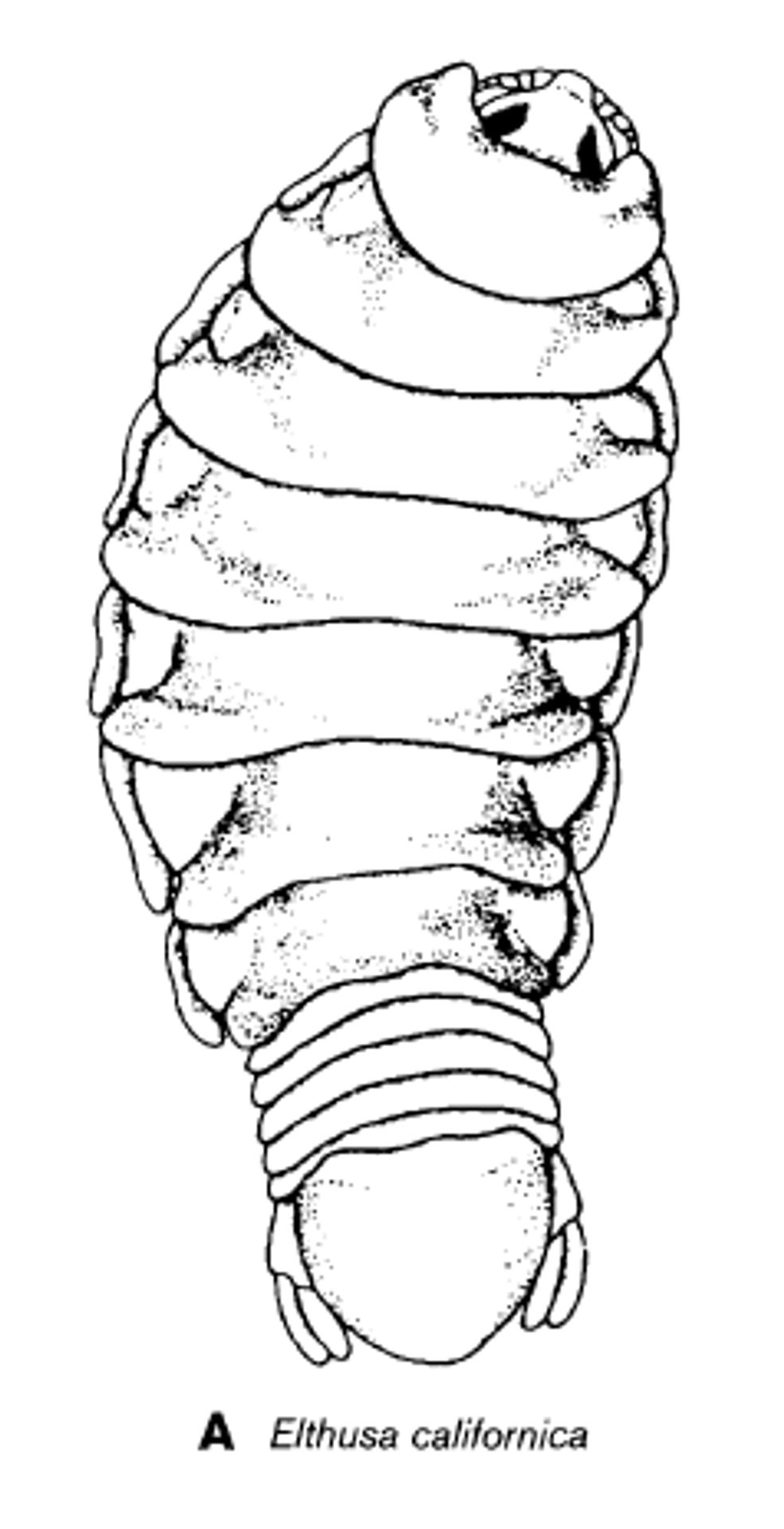
Distinguished from by combination of: oblong-oval vaulted body ~16 mm long; slightly twisted body due to asymmetric length; triangular with non-trilobed margin; close-set separated by approximately one eye-width; antennule shorter than all pleopod and reaching only seventh article of ; female pleotelson width equal to length. Formerly placed in Lironeca, now recognized as Elthusa based on cephalon and thoracic .
Images
Appearance
Body oblong-oval, vaulted, approximately 16 mm long by 7 mm wide, with length roughly twice the width. Body slightly twisted due to shorter right side. triangular, about 2 mm wide, with strong blunt outline; margin not trilobed. Two large oval positioned close-set on postlateral angles. Two pairs of , each with eight or nine articles; antennule shorter and more slender than antenna, extending only to seventh article of larger pair. Maxillipeds with two articles; palps with three articles. of eight segments with embedded head as largest segment (~2 mm); segments two and three equal (~1.5 mm); segments four through six ~1 mm; seventh segment shortest (~0.5 mm). Epimerae narrow, fully extending across posterior thoracic segments. Terminal thorax posterior, ~4 mm wide by 3.5 mm long. Legs grasping, with long slender dactyli. female pleotelson as wide as long. Juveniles with color pigment concentrated in melanophores, lacking distinct pattern.
Habitat
Marine coastal waters. Attaches inside opercular cavity of fish gill chamber. Shows preference for benthic hosts and demersal schooling fish.
Distribution
Pacific coast of North and South America: California (type locality near San Francisco), north to Canada, south to Peru.
Diet
Feeds on blood and tissue of fish inside gill chamber.
Host Associations
- Cymatogaster aggregata - actinopterygian fish
- Atherinops affinis - actinopterygian fish
- Artedius lateralis -
- Clinocottus analis -
- Oligocottus maculosus -
- Scorpaenichthys marmoratus - recorded as S. marmoratus
- Fundulus parvipinnis -
Behavior
Attaches to using seven pairs of sharply hooked legs and specialized mouthparts. Creates protruding shape when attached in gill chamber. Capable of cross- and hybridization with congeneric including E. vulgaris.
Ecological Role
influencing growth through blood loss. May reduce host vitality during low salinity events. Considered relatively benign , not typically fatal to hosts. Proposed as for environmental change due to smaller body size and less complex structure compared to .
Similar Taxa
- Elthusa vulgaris with which E. californica can hybridize; distinguished by morphological differences in body proportions and associations
- Lironeca spp.Formerly placed in this ; Elthusa distinguished by non-trilobed cephalon margin and other thoracic characters
More Details
Taxonomic history
Originally described as Lironeca californica by Schioedte & Meinert in 1884. Transferred to Elthusa following taxonomic revision of the , reflecting updated understanding of cymothoid generic boundaries based on cephalic and thoracic .
Hybridization potential
Documented capability of cross- with E. vulgaris, suggesting potential for genetic exchange between sympatric or overlapping .