
Elthusa
Schioedte & Meinert, 1884
Species Guides
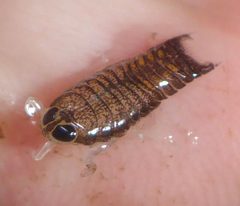
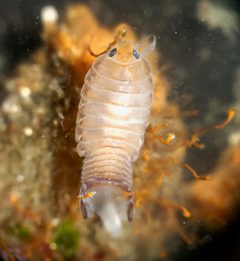
1Elthusa is a of cymothoid isopods comprising approximately 40 described of obligate fish . Species in this genus are characterized by branchial , attaching to the gill filaments of marine fish where they feed on blood and tissue fluids. The genus has a worldwide distribution with records from the Atlantic, Indian, and Pacific Oceans. Several species have been described from South Africa, New Caledonia, Taiwan, and Japan, with some exhibiting host specificity while others parasitize multiple fish species.
Pronunciation
How to pronounce Elthusa: /ˈɛl.θuː.sə/
These audio files are automatically generated. While they are not always 100% accurate, they are a good starting point.
Identification
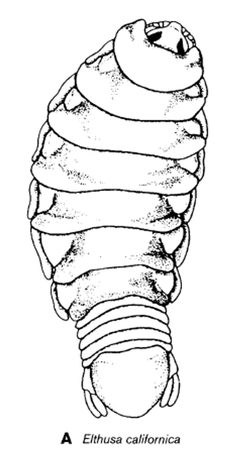
Elthusa can be distinguished from other cymothoid by their branchial attachment habit and specific morphological features. Diagnostic characters include body shape (typically elongated and ovoid in females), degree of cephalon immersion into pereonite 1, visibility and position of relative to amphicephalic processes, relative proportions of pereonites 3–7 (which typically decrease in size posteriorly), and pleonite width progression. Species-level identification requires examination of pleotelson shape, uropod length and form, and details of pereopod 7 merus and carpus structure. Females are generally larger than males and may be ovigerous.
Images
Habitat
Marine; primarily associated with the branchial cavities of teleost and elasmobranch fishes. occur in coral reef , coastal waters, and deep-sea environments to at least 458 meters depth. Attachment site is typically the gill filaments, though accidental occurrences in buccal cavities have been recorded.
Distribution
Worldwide in marine waters. Documented from South Africa (Atlantic and Indian Ocean coasts), New Caledonia (Southwestern Pacific), Taiwan, Japan, Egypt (eastern Mediterranean), and the Indian Ocean (southwest coast of India). The has been recorded in both native and fish , including Lessepsian migrant in the Mediterranean.
Diet
; feeds on blood and tissue fluids extracted from gill filaments. Some produce anticoagulant compounds (termed 'occipodins') to facilitate blood feeding.
Host Associations
- Epinephelus howlandi (blacksaddle grouper, Serranidae) - obligate branchial type for E. epinepheli; first Elthusa reported from Epinephelus
- Lagocephalus sceleratus (silver cheeked toadfish) - branchial and buccal cavity in eastern Mediterranean; 23.9% reported from Egyptian coast
- Clinus supercilious (Super klipfish) - branchial intertidal ; first record of Elthusa from any klipfish ( Clinus)
- Etmopterus sp. (lantern shark, Etmopteridae) - accidental attachmentabnormal mouth attachment in Taiwan; not natural gill chamber occurrence
- Various marine teleosts and elasmobranchs - branchial multiple records across ; see taxonomic revisions for complete host lists
Life Cycle
Development includes , embryonic, and manca stages. Females are ovigerous, carrying eggs in a pouch. stages (manca) have been described for some . life stages include females (ovigerous and non-ovigerous), males, transitional forms, and juveniles. Specific developmental details vary among species and are incompletely documented for most.
Behavior
Obligate ectoparasitism with specialized attachment to gill filaments. Attachment orientation typically positions the body against the gill surface with structures pressing against the inner wall. Normal excludes buccal cavity occupation; accidental mouth attachments represent atypical positioning. Isopods induce pathological changes in host tissue including curling and loss of secondary gill , mucous exudation, and granuloma formation.
Ecological Role
of marine fishes; may influence through gill damage and blood loss. Potential role in parasite transmission between native and host , as documented with Lessepsian migrant fishes in the Mediterranean. Population-level impacts on host have not been quantified.
Human Relevance
Source of natural product anticoagulants (occipodins) with potential biomedical applications. E. vulgaris has been studied for proteinaceous anticoagulant compounds active on the intrinsic coagulation . Some may impact fisheries through of commercially important grouper species.
Similar Taxa
- BrucethoaFormerly included now transferred to Brucethoa; distinguished by deep-sea , associations with Chlorophthalmidae, and specific morphological features including body proportions and coxal structure
- Other Cymothoidae genera (Livoneca, Nerocila, etc.)Elthusa distinguished by branchial attachment habit versus buccal or external body attachment; morphological differences in cephalon structure, pleonite proportions, and uropod
More Details
Taxonomic history
The was established by Schioedte & Meinert in 1884. Recent revisions have transferred several to other genera, including two species moved to Brucethoa in 2024. South African fauna revised in 2019, increasing known regional species from one to four.
Research significance
Elthusa are important models for studying marine fish , - , and . The has contributed to understanding Lessepsian impacts on Mediterranean parasite fauna.
Sources and further reading
- BugGuide
- Wikipedia
- GBIF taxonomy match
- iNaturalist taxon
- NCBI Taxonomy
- Catalogue of Life
- Zookeys | Blog - Part 19
- An accidental attachment of Elthusa raynaudii (Isopoda, Cymothoidae) in Etmopterus sp. (Squaliformes, Etmopteridae)
- Elthusa epinepheli sp. nov. (Crustacea, Isopoda, Cymothoidae) a branchial parasite of the grouper Epinephelus howlandi (Serranidae, Epinephelinae) from off New Caledonia
- Preliminary Characterization of Occipodins, Natural Product Anticoagulants from Hematophagous Marine Parasites, Isopod Elthusa vulgaris and Copepod Phrixocephalus Cincinnatus.
- A new species and new host records of the genus <i>Elthusa</i> (Crustacea: Isopoda: Cymothoidae) from Japan
- Review of the fish parasitic genus Elthusa Schioedte & Meinert, 1884 (Crustacea, Isopoda, Cymothoidae) from South Africa, including the description of three new species
- Phylogeny and ultrastructure of Elthusa raynaudii (Isopoda, Cymothoidae) firstly recorded from the invasive silver cheeked toadfish (Lagocephalus sceleratus) (Gmelin 1789) in eastern Mediterranean Sea coast
- A new species of branchial fish parasitic deep-sea isopod, Brucethoa Aneesh, Hadfield, Smit & Kumar, 2020 (Isopoda: Cymothoidae) from the Indian Ocean, with the transfer of two Elthusa Schioedte & Meinert, 1884 species