
Gammarus mucronatus
Say, 1818
scud
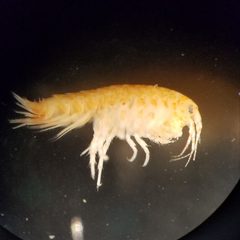
Gammarus mucronatus is a small amphipod crustacean first described in 1818. It is a in salt marsh and estuarine along the North American Atlantic coast and Gulf of Mexico. The is multivoltine, producing multiple per season with overlapping cohorts. It serves as an important food source for fish and other while contributing significantly to energy flow and nutrient cycling in coastal .
Pronunciation
How to pronounce Gammarus mucronatus: //ˈɡæməɹəs ˌmjuːkɹoʊˈneɪtəs//
These audio files are automatically generated. While they are not always 100% accurate, they are a good starting point.
Identification
Distinguished from other Gammarus by its small size, multivoltine reproductive strategy with overlapping cohorts, and eurytopic to wide salinity ranges (4–35‰). In the northwestern Atlantic, it co-occurs with G. wilkitzkii (larger, single autumn , Arctic distribution) and G. stoerensis (small broods spring to autumn, Atlantic amphiboreal distribution), from which it differs in reproductive and geographic range. G. mucronatus produces summer broods of small , in contrast to the winter of G. wilkitzkii.
Images
Appearance
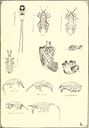
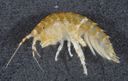
Small amphipod measuring 3.5–6.5 mm in length. Body is laterally compressed with no , a characteristic synapomorphy of amphipods. in size has been observed, with ovigerous and mature females showing reduced body size in summer months compared to winter. The name 'mucronatus' refers to a mucronate (pointed) feature, though specific morphological details of this trait are not detailed in available sources.
Habitat
Eurytopic capable of tolerating wide ecological conditions. Found in shallow coastal waters, salt marsh pools, estuaries, and marine environments. Specific microhabitats include , seagrass beds, sponges, Spartina marshes, soft bottoms with shells or cobbles, oyster bars, and open beaches. Benthic, living at the bottom of water bodies. In Massachusetts salt marshes, densities are positively associated with floating algal mats dominated by Cladophora spp. Tolerates salinity from 4 to 35‰.
Distribution
North American Atlantic seaboard from southwestern Newfoundland south to the Gulf of Mexico. Documented from northern Massachusetts salt marshes (Parker River National Wildlife ), York River in Virginia, and throughout the warm temperate estuarine of the mid-Atlantic and southeastern United States.
Seasonality
Active year-round in suitable . Reproductive activity peaks in summer with multivoltine breeding. peaks in late June in studied . First juveniles appear in April in northern Massachusetts; first mature in May. Last cohort begins in November, with individuals maturing at larger sizes than summer cohorts. Winter and summer populations exhibit different reproductive strategies.
Diet
with diversified feeding habits. Consumes detritus, microalgae, and macroalgae. Has been observed to possibly consume other macrofauna. Lacks enzymatic activity for breaking down structural plant polysaccharides, but can process starch and laminarin by breaking glycosidic linkages in smaller molecules. In seagrass beds, engages in grazing of seagrass epiphytes and participates in decomposition processes.
Life Cycle
Multivoltine with overlapping cohorts. development lasts a mean of 31 days. Mean cohort interval is 112 days with mean turnover rate (P:B) of 4.3. Females produce 3–200 depending on body size; larger females produce more eggs. Egg size varies from 0.308 to 0.532 mm, decreasing seasonally from winter to summer. Summer cohorts exhibit reduced egg size, brood size, development time, size at maturity, and maximum size compared to winter . Most mature females are ovigerous. production ranges from 12.4–15.8 g m⁻² yr⁻¹ dry weight.
Behavior
Benthic lifestyle, living at the bottom of water bodies. In seagrass , activity influenced by presence of macroalgae, which reduces risk from fish. Energy flow through the equivalent to 5.8% of net in studied salt marsh pools. Growth varies by cohort: highest (0.56) in first spring cohort, lowest (0.34–0.37) in midsummer cohorts. Mean growth efficiency 0.50 when coupled with production.
Ecological Role
Important secondary producer in coastal and estuarine . Serves as prey for large decapods, crustaceans, and and fishes including the striped killifish (Fundulus majalis). Contributes to nutrient cycling through detritivory and grazing on epiphytes. Participates in decomposition processes in seagrass beds. Energy flow through the represents a significant portion of . pressure on the species is mediated by structure, with macroalgae presence reducing fish predation and potentially creating alternative stable states in .
Human Relevance
No direct economic or human health significance documented. Serves as an for estuarine health due to its sensitivity to conditions and its role as a amphipod in salt marsh systems. Scientific interest in the focuses on its productivity, strategies, and role in coastal .
Similar Taxa
- Gammarus wilkitzkiiCircumpolar Arctic with single large autumn of large ; larger body size; matures at larger size; distinct geographic and reproductive strategy
- Gammarus stoerensisAtlantic amphiboreal distribution (Nova Scotia to Rhode Island); small with series of small spring to autumn; resting stage in late winter; differs in reproductive
More Details
Reproductive plasticity
Winter and summer exhibit markedly different reproductive strategies, with summer individuals showing reduced investment per offspring (smaller , smaller , faster development) but higher turnover rates. This phenotypic plasticity may represent an adaptive response to seasonal variation in environmental conditions and pressure.
Productivity significance
In Parker River National Wildlife salt marsh pools, G. mucronatus was the amphipod and contributed more than half of amphipod production through its first spring cohort alone. The demonstrates high secondary production capacity with turnover rates comparable to or exceeding those of many other aquatic .
Sources and further reading
- BugGuide
- Wikipedia
- GBIF taxonomy match
- iNaturalist taxon
- NCBI Taxonomy
- Catalogue of Life
- Field research in Turkmenistan’s highest mountain reveals high biological diversity | Blog
- Insects roasting on an open fire: Bess beetles, Passalidae, carpenter ants, Formicidae, darkling beetles, Tenebrionidae, and longhorn beetles, Cerambycidae — Bug of the Week
- Uncategorized | Blog - Part 31
- The biology of Gammarus (Crustacea, Amphipoda) in the northwestern Atlantic. IX. Gammarus wilkitzkii Birula, Gammarus stoerensis Reid, and Gammarus mucronatus Say
- Life History of Gammarus mucronatus Say (Amphipoda: Gammaridae) in Warm Temperate Estuarine Habitats, York River, Virginia
- LIFE HISTORY OF GAMMARUS MUCRONATUS SAY (AMPHIPODA: GAMMARIDAE) IN WARM TEMPERATE ESTUARINE HABITATS, YORK RIVER, VIRGINIA
- SECONDARY PRODUCTION OF GAMMARUS MUCRONATUS SAY (AMPHIPODA: GAMMARIDAE) IN WARM TEMPERATE ESTUARINE HABITATS, YORK RIVER, VIRGINIA
- Secondary Production of Gammarus mucronatus Say (Amphipoda: Gammaridae) in Warm Temperate Estuarine Habitats, York River, Virginia
- The life cycle and productivity of the amphipod Gammarus mucronatus on a northern Massachusetts salt marsh