
Haustorius canadensis
Bousfield, 1962
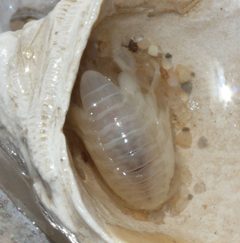
Haustorius canadensis is a sand-burrowing amphipod in the Haustoriidae, found in sandy beach of northern New England. The exhibits a mixed – , with approximately half the reproducing after one year and the remainder after two years. It is a member of intertidal macro-infauna , co-occurring with Acanthohaustorius millsi and Amphiporeia virginiana. show seasonal movements upshore in spring and downshore in autumn and winter.
Pronunciation
How to pronounce Haustorius canadensis: /haʊsˈtɔːriəs kænəˈdɛnsɪs/
These audio files are automatically generated. While they are not always 100% accurate, they are a good starting point.
Images
Habitat
Sandy marine intertidal and shallow subtidal zones; sand-burrowing found in beach of northern New England. The species shows seasonal shore movements, shifting upshore during spring and downshore during autumn and winter.
Distribution
Northern New England, east coast of North America; specifically documented from southern Maine and the southern shore of Cape Cod, Massachusetts. GBIF records indicate presence in the Northwest Atlantic.
Seasonality
Breeding occurs from May through September. recruitment takes place in July and August. densities peak in summer and reach lowest levels in winter.
Life Cycle
Mixed – : approximately 50% of individuals reproduce after one year, remainder after two years. development takes 4–5 weeks at 15°C. Females produce multiple per season with 2–22 eggs per brood (mean 7.6). Minimum reproductive female size approximately 6 mm.
Behavior
Sand-burrowing; exhibits seasonal vertical on shore, moving upshore in spring and downshore in autumn and winter.
Ecological Role
member of sandy beach macro-infauna ; key contributor to secondary production and energy flow in intertidal sand . Co-dominates with Acanthohaustorius millsi and Amphiporeia virginiana in these .
Similar Taxa
- Acanthohaustorius millsiCo- haustoriid amphipod in same sandy beach of northern New England; distinguished by morphological features of the Acanthohaustorius
- Amphiporeia virginianaCo- amphipod in same intertidal sand ; belongs to Pontoporeiidae rather than Haustoriidae
More Details
Life history variation
The mixed – pattern in southern Maine contrasts with the strictly annual life history observed on the southern shore of Cape Cod, suggesting a latitudinal gradient in life history strategy correlated with temperature.
Sexual dimorphism
Males reach larger maximum sizes than females despite females being the minimum size for (approximately 6 mm). Sex ratio remains close to 1:1 throughout the year.
Sources and further reading
- BugGuide
- Wikipedia
- GBIF taxonomy match
- iNaturalist taxon
- NCBI Taxonomy
- Catalogue of Life
- Bug Eric: Spider Sunday: Red Velvet Jumper
- Bug Eric: True Bug Tuesday: Mirid plant bug
- Snake Road | Beetles In The Bush
- Melanthiaceae | Beetles In The Bush
- Vampire Moths Suck the Blood of Vertebrates, Including Humans
- Production Ecology of Haustorius Canadensis (Amphipoda: Haustoriidae) in Southern Maine
- Life-history patterns of Haustorius canadensis (Crustacea: Amphipoda) in northern New England