
Haustoriidae
Stebbing, 1906
Genus Guides
1Haustoriidae is a of amphipod crustaceans characterized by stout, robust bodies adapted for burrowing in sandy sediments. They are members of intertidal and shallow subtidal sandy beach along the Atlantic coast of North America, with some extending into the Gulf of Mexico and Pacific coast. The family radiated during the Eocene, with the Pacific- Eohaustorius representing the most basal lineage, diverging approximately 31 million years ago. Haustoriidae are distinguished from other amphipod families by their specialized for sand-burrowing and their limited capabilities, which have resulted in strong structure and cryptic diversity across their range.
Pronunciation
How to pronounce Haustoriidae: //haʊˈstɔːri.aɪdiː//
These audio files are automatically generated. While they are not always 100% accurate, they are a good starting point.
Identification
Distinguished from other amphipod by stout, compact body form specialized for sand-burrowing. Within the family, can be separated by pereiopod patterns and presence or absence of spiny projections: Lepidactylus has distinctive triarticulate pereiopods, Acanthohaustorius bears spines, Parahaustorius and Haustorius differ in gnathopod and uropod . -level identification requires examination of appendage details and often molecular data due to cryptic diversity; multiple cryptic operational taxonomic units have been identified within morphologically similar species such as Lepidactylus triarticulatus and Haustorius galvezi. Intertidal species generally occupy coarser sediments than subtidal species, which can aid in field identification.
Images
Appearance
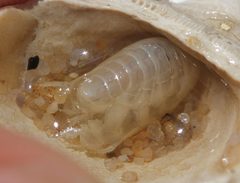
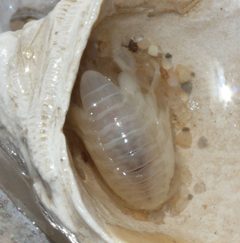
Stout-bodied, robust amphipods with specialized for burrowing in sand. Body form is compact and muscular compared to more elongate amphipod . Specific morphological characters vary among ; members of Lepidactylus possess distinctive patterns in the pereiopods, while Acanthohaustorius bears spiny projections. is present, with males and females differing in size and reproductive morphology. Body size varies among and correlates with size within the family.
Habitat
Sandy marine sediments, primarily in intertidal and shallow subtidal zones of open coast beaches. Specific sediment preferences vary by : intertidal species select coarser sediments than subtidal species. Distribution within beach systems influenced by sediment permeability, penetrability, and stability. Some species occur in muddier sediments at lower salinities; others colonize warm brackish waters in protected bays. Vertical zonation observed, with species separated horizontally and vertically in the sand column, reducing competitive overlap.
Distribution
North Atlantic coast of North America, from northern New England to the southeastern United States; Gulf of Mexico; Pacific coast of North America (via Eohaustorius). European records present (Denmark, Norway, Sweden) though these require verification. Distribution patterns reflect historical vicariance, with deep divergences across the Mississippi River and ancient zones in the Gulf of Mexico. Limited abilities result in strong structure and regional .
Seasonality
breeding cycle in temperate , with first ovigerous females appearing when water temperatures reach 5.5–14°C depending on species. Timing varies: Haustorius canadensis and Neohaustorius biarticulatus begin breeding at approximately 14°C, while subtidal species Acanthohaustorius millsi, Parahaustorius longimerus, and Protohaustorius deichmannae initiate at 5.5–10°C. Subtidal species migrate into sands just below the low tide zone in May and remain until late August, then move to deeper waters. Seasonal temperature and hydrological conditions influence distribution and abundance.
Life Cycle
documented in multiple . Breeding occurs once yearly in most species, though some such as Protohaustorius deichmannae produce more than one . Ovigerous females carry broods of ; brood size linearly with female dry body weight. Brood weight ranges from 8% to 16% of female dry body weight depending on species. Embryonic development occurs in marsupium; juveniles emerge and grow through successive . Growth patterns and have been documented for several Cape Cod .
Behavior
Specialized burrowing in sand, with -specific preferences for sediment particle size. Intertidal species tolerate air exposure at high relative humidity and show greater resistance to high water temperature than subtidal species. Sediment preference can be modified by organic content; drying or igniting sediment alters attractiveness to intertidal species. Swimming behavior occurs during pelagic phases, with current speed influencing . Low oxygen varies: Acanthohaustorius millsi is most tolerant to hypoxia, while Haustorius canadensis has the lowest oxygen consumption rate among studied species.
Ecological Role
macro-infauna in sandy beach of eastern North America, comprising key contributors to secondary production and energy flow. High densities support production of these systems. partitioning through vertical and horizontal segregation in sediment reduces . Serve as prey for higher in sandy beach . and strategies influence structure and ecosystem function in intertidal and shallow subtidal .
Human Relevance
Subject of ecological and systematic research due to dominance in sandy beach and utility as model organisms for biogeographic studies. size variation within the has contributed to understanding of rapid genomic evolution. No direct economic importance documented; not known as pests or commercially harvested. Presence indicates healthy sandy beach function.
Similar Taxa
- BathyporeiidaeAlso sand-burrowing amphipods with superficially similar preferences, but distinguished by phylogenetic placement, geographic distribution, and morphological details of appendages.
- PontoporeiidaeFreshwater and brackish-water burrowing amphipods with convergent body forms; distinguished by preference and reproductive .
- OedicerotidaeMarine burrowing amphipods with different body proportions and burrowing mechanics; Haustoriidae are more stout-bodied and specialized for sand rather than mud.
More Details
Genome evolution
Remarkable 6-fold size variation exists within Haustoriidae despite the clade being less than 7 million years old. Genome size correlates with body length but not latitude. Largest genomes driven by expansions of LINE repetitive elements. Two independent lineages that colonized warm brackish waters show evidence of genomic purging and body size reduction, suggesting strong physiological constraints on transitions.
Phylogenetic position
Molecular supports Haustoriidae as basal gammarid amphipods. The parvorder 'Haustoriidira' is polyphyletic and should be abandoned. Eohaustorius is the most basal , having separated from remaining Haustoriidae approximately 31 million years ago. radiation initiated during the Eocene, possibly driven in North America by coastal availability following the Chesapeake Bay impact crater event.
Biogeographic significance
Strong structure and limited make haustoriid amphipods ideal model organisms for studying open coast and vicariance. Deep genetic divergences across the Mississippi River and within the Gulf of Mexico exceed timing of previously proposed vicariant hypotheses, consistent with Miocene sedimentation acting as an east-west barrier to .
Sources and further reading
- BugGuide
- Wikipedia
- GBIF taxonomy match
- iNaturalist taxon
- NCBI Taxonomy
- Catalogue of Life
- Description of the Male of Amphiporeia Gigantea Bousfield (Amphipoda, Haustoriidae)
- Production Ecology of Haustorius Canadensis (Amphipoda: Haustoriidae) in Southern Maine
- Origin and evolution of the Haustoriidae (Amphipoda): A eulogy for the Haustoriidira
- Life history of the sandy-beach amphipod Neohaustorius schmitzi (Crustacea: Haustoriidae)
- Rapid genomic expansion and purging associated with habitat transitions in a clade of beach crustaceans (Haustoriidae: Amphipoda)
- Acanthohaustorius uncinus, a New Species of Sand-Burrowing Amphipod from the Northern Gulf of Mexico, with Notes on its Ecology (Haustoriidae: Haustoriinae)
- Two new species of sand-burrowing amphipods of the genus Haustorius Müller, 1775 (Amphipoda: Haustoriidae) from the northwestern Gulf of Mexico
- Comparative Ecology, Life Histories, and Behaviour of Intertidal Sand-Burrowing Amphipods (Crustacea: Haustoriidae) at Cape Cod
- Systematics and ecology of the estuarine amphipod crustacean Lepidactylus dytiscus Say, 1818 (Haustoriidae)
- Some Aspects of the Ecology and Life Cycle of Three Species of Subtidal Sand-Burrowing Amphipods (Crustacea: Haustoriidae)
- Physiological Tolerances and Behaviour Responses of Five Species of Haustoriidae (Amphipoda: Crustacea) to Five Environmental Factors
- Rapid genomic expansion and purging associated with habitat transitions in a clade of beach crustaceans (Amphipoda: Haustoriidae)
- The ecology of Bathyporeia pilosa (Amphipoda: Haustoriidae) in the Tay Estuary. II. Factors affecting the micro-distribution
- Phylogeography of sand‐burrowing amphipods (Haustoriidae) supports an ancient suture zone in the Gulf of Mexico
- The ecology of Bathyporeia pilosa (Amphipoda: Haustoriidae) in the Tay Estuary. I. Factors influencing the distribution on Tayport and Tentsmuir beaches