
Arenaeus cribrarius
(Lamarck, 1818)
Speckled Swimming Crab
Arenaeus cribrarius, the speckled swimming crab, is a portunid crab distributed throughout the western Atlantic from Massachusetts to Argentina. It inhabits shallow sandy substrates but occurs to depths of 61 m, burying itself in sediment while maintaining respiratory water flow through a maintained gap. The exhibits , solitary and is an opportunistic feeder that ambushes prey from its buried position. It supports commercial fisheries, particularly along the Brazilian coast, and has demonstrated reproductive plasticity in response to pressures.
Pronunciation
How to pronounce Arenaeus cribrarius: /ɑːrɛˈniːəs krɪˈbrəriəs/
These audio files are automatically generated. While they are not always 100% accurate, they are a good starting point.
Identification
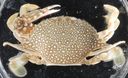
Distinguished from Arenaeus mexicanus by number of rostral teeth, number of carpal spines, and presence of spine on epistome region (diagnostic per molecular and morphological revision). Differs from Callinectes sapidus by spotted rather than blue coloration, and by lateral tooth count and arrangement. Distinguished from other portunids by combination of: six partially frontal teeth, nine lateral teeth with extended ninth tooth, and irregular spotted pattern.
Images
Appearance
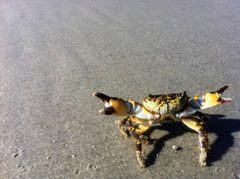
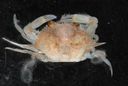
light brown, light maroon, or olive with numerous irregular white or tan round spots; males typically more colorful. Carapace width 120–150 mm (4.5–6 inches), maximum weight approximately 45 g. Nine lateral teeth on each side of carapace, with the ninth tooth extending outward. Six partially frontal teeth between sockets. Fifth pair of pereiopods modified as broad, flattened paddles for swimming; first four pairs of legs with yellow tips. Overall body form similar to Callinectes sapidus (Atlantic blue crab).
Habitat
Shallow sandy substrates on ocean beaches; juveniles more abundant in shallower areas while associated with finer sediments and deeper waters. Burrows completely in sand, maintaining gap for respiratory water flow. Temperature range 11–29°C, salinity 28–35 PSU. Nursery grounds identified in coastal waters of southern Brazil.
Distribution
Western Atlantic Ocean: Massachusetts, USA to Argentina. Continuous distribution along Atlantic coast of Americas with no geographic partitioning in COI analyses, suggesting high across range.
Seasonality
Year-round activity; ovigerous females present throughout year with higher frequencies during warmer months. Juveniles show temporal distribution patterns with abundance varying by season in nursery areas.
Diet
Primarily detritivorous; also consumes fish, mollusks, other crustaceans, and sea turtle hatchlings. Ambush that captures prey passing near buried body.
Life Cycle
Sexual maturity at 5–7 years (though average lifespan approximately 2 years, suggesting high mortality). Mating involves 30-day precopulatory pair formation with male carrying premolt female; copulation occurs post- when female shell still soft. spawn approximately 57 days post-mating; 135,000–680,000 eggs per female. Nauplii hatch at 18 days; first crab stage reached 13 days later. Juveniles and show distinct bathymetric distribution with shallow nursery areas for juveniles.
Behavior
and solitary; buries completely in sand maintaining respiratory gap cleared by claws and mouth-area setae. Only interaction is for breeding. may seek colder, deeper, nutrient-rich waters.
Ecological Role
and scavenger; nursery ground function in coastal Brazil maintains regional . Prey for sea turtles (primary predator).
Human Relevance
Commercially harvested for meat in Brazilian fisheries; byproducts used for fertilizers, livestock feed, extraction for adhesives, cosmetics, photographic emulsions, and anticoagulants.
Similar Taxa
- Arenaeus mexicanusSister with mirrored Pacific distribution; distinguished by rostral tooth count, carpal spine number, and epistome spine presence
- Callinectes sapidusSimilar overall body shape; distinguished by blue coloration versus spotted pattern, and different lateral tooth
More Details
Reproductive plasticity
decline has been associated with adaptive reproductive responses including altered size at maturity and modified patterns, demonstrating phenotypic plasticity in reproductive traits.
Handedness
73% of specimens measured in Fortaleza Bay study were right-handed (chela asymmetry).
Sex ratio
Female-biased overall (1:1.42) in pooled data from Ubatuba, though spatially and seasonally variable; males dominate larger size classes.
Sources and further reading
- BugGuide
- Wikipedia
- GBIF taxonomy match
- iNaturalist taxon
- NCBI Taxonomy
- Catalogue of Life
- Reproductive Plasticity in the Speckled CrabArenaeus cribrarius(Decapoda, Brachyura, Portunidae) Associated with a Population Decline
- Reproduction of the Speckled Swimming Crab Arenaeus Cribrarius (Brachyura: Portunidae) on the Brazilian Coast near 23°30′s
- Temporal and bathymetric distribution of juveniles and adults of the speckled swimming crab Arenaeus cribrarius from coastal waters of southern Brazil
- Historical background of the population biology of the swimming crab Arenaeus cribrarius (Crustacea: Portunidae) in the Ubatuba coast, southeast Brazil
- REPRODUCTION OF THE SPECKLED SWIMMING CRAB ARENAEUS CRIBRARIUS (BRACHYURA: PORTUNIDAE) ON THE BRAZILIAN COAST NEAR 23°30′S
- Taxonomic revision of the speckled crabs, genus Arenaeus Dana, 1851 (Brachyura: Portunidae) based on morphological and molecular data