
Taliepus
A. Milne-Edwards, 1878
kelp crab, spider crab
Species Guides
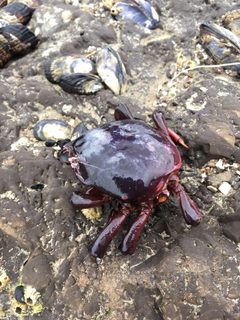
1- Taliepus nuttallii(southern kelp crab)
Taliepus is a of kelp and spider crabs comprising at least three described . Species in this genus are associated with kelp forest , primarily along the Pacific coast of South America. Research has focused extensively on Taliepus dentatus, revealing complex reproductive strategies including single paternity despite polyandrous mating, and thermal in larval stages. The genus exhibits traits shaped by kelp forest structure, with habitat-specific demographic patterns documented in Taliepus marginatus.


Pronunciation
How to pronounce Taliepus: //ˈtæ.li.eɪ.pʊs//
These audio files are automatically generated. While they are not always 100% accurate, they are a good starting point.
Identification
Members of Taliepus can be distinguished from other Epialtidae by their association with kelp and morphological adaptations for clinging to macroalgae. Specific diagnostic features for -level identification require examination of shape, rostral spines, and male ; these traits are best assessed with reference to taxonomic keys for Majoidea. The three described (T. dentatus, T. marginatus, T. nuttallii) differ in distribution and subtle morphological characters.
Images
Habitat
Kelp forests and subtidal dominated by macroalgae, particularly Macrocystis pyrifera and Lessonia trabeculata. Taliepus marginatus shows habitat partitioning: and crabs are more abundant in dense Macrocystis pyrifera forests, while reproductive predominate in more open Lessonia trabeculata stands.
Distribution
Pacific coast of South America, with documented in Chile. Taliepus dentatus occurs across multiple latitudes with locally adapted populations; Taliepus marginatus occurs in northern Chile; Taliepus nuttallii (southern kelp crab) distribution requires verification.
Diet
Taliepus marginatus exhibits ontogenetic dietary shifts: smaller crabs consume higher proportions of kelp tissues, while larger crabs incorporate more animal food. Feeding occurs primarily nocturnally in both kelp forest types.
Life Cycle
Direct development through brooded embryos to planktonic zoea larvae. Female T. dentatus embryos with development time negatively affected by temperature. Zoea I larvae are planktonic and subject to temperature-dependent survival and performance. Larval thermal varies between , suggesting local . Short copulatory durations and full seminal receptacles contribute to single paternity patterns.
Behavior
feeding activity with higher food consumption at night. Female are plastic and respond to temperature and hypoxia stressors, including increased embryo ventilation under high temperature and low dissolved oxygen conditions. Males rarely mate or display guarding behavior when other males are present, indicating sperm competition avoidance. Females are receptive approximately 50% of the time but do not exhibit mate selection during pre-copulatory periods.
Ecological Role
Taliepus marginatus functions as both herbivore and omnivore in kelp forest , with ontogenetic shifts in trophic position. crabs serve as nursery inhabitants in dense Macrocystis pyrifera forests, while occupy reproductive in Lessonia trabeculata stands. The contributes to kelp forest trophic dynamics and may influence macroalgal tissue consumption patterns.
Human Relevance
Subject to male-biased fishing pressures; T. dentatus has evolved reproductive strategies including year-round mating success and sperm storage capabilities that may buffer against demographic skew from selective harvest. Thermal studies have used this as a model for understanding climate change effects on marine larvae.
Similar Taxa
- PugettiaAnother kelp crab in Epialtidae; distinguished by shape and rostral spine
- EpialtusType of Epialtidae; Taliepus differs in specific and characteristics
More Details
Reproductive Biology
Taliepus dentatus exhibits genetic monogamy (single paternity) despite polyandrous mating , a pattern distinct from other majid crabs. The seminal receptacle is non-compartmentalised, supporting the sperm economy hypothesis. This reproductive strategy appears resilient to male-biased fishing pressures.
Thermal Adaptation
Larval of T. dentatus show local to thermal regimes: northern populations (23°C ) have critical thermal maxima approximately 3°C higher than southern populations (16°C habitat). This difference persists after common garden rearing, indicating genetic rather than acclimatory basis.
Sources and further reading
- BugGuide
- Wikipedia
- GBIF taxonomy match
- iNaturalist taxon
- NCBI Taxonomy
- Catalogue of Life
- Single paternity in the kelp crab Taliepus dentatus despite polyandry
- Thermal tolerance of crustacean larvae (zoea I) in two different populations of the kelp crabTaliepus dentatus(Milne-Edwards)
- Combined effects of temperature and hypoxia shape female brooding behaviors and the early ontogeny of the Chilean kelp crab Taliepus dentatus
- The Effects of Temperature on the Swimming Performance, Starvation‐Survival and Morphometrics of Zoea 1 Larvae of the Kelp Crab (Taliepus dentatus) From Central Chile
- Demography and feeding behavior of the kelp crab Taliepus marginatus in subtidal habitats dominated by the kelps Macrocystis pyrifera or Lessonia trabeculata