
Orconectes rusticus
(Girard, 1852)
Rusty Crayfish
Orconectes rusticus, commonly known as the rusty crayfish, is a freshwater crayfish native to the Ohio River basin in the United States. The has become a highly successful organism in northern lakes and streams across North America, where it displaces native crayfish through aggressive behavioral dominance. Research has documented its capacity for learned associations involving cues, complex social recognition systems using chemical signals, and flexible spatial learning. The species' invasion success stems from a combination of behavioral traits including high aggression, broad , and efficient resource utilization.
Pronunciation
How to pronounce Orconectes rusticus: /ɔrkoʊˈnɛktiːz ˈrʌstɪkəs/
These audio files are automatically generated. While they are not always 100% accurate, they are a good starting point.
Identification
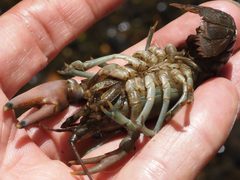
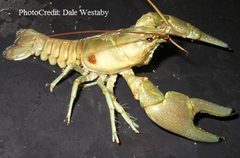
Orconectes rusticus can be distinguished from similar native crayfish by its characteristic rusty spots on either side of the , which give the its . The species typically exhibits larger and more robust claws compared to many native , with black banding on the claw tips. reach a maximum carapace length of approximately 45 mm. The species' aggressive in direct encounters often serves as a behavioral indicator when observed in mixed-species .
Images
Habitat
Native inhabit streams and rivers, particularly in the Ohio River basin. populations have colonized diverse freshwater including lakes, ponds, and streams across northern North America. Research in Kentucky documented that O. rusticus occupies lower stream reaches with warmer temperatures, avoiding headwater areas with constant 12–14°C temperatures. The shows preference for open stream environments and is primarily epigean, in contrast to some that utilize subterranean habitats.
Distribution
Native range is restricted to the Ohio River basin in the United States. The has been introduced and established across the northern United States and southern Canada, including the Great Lakes region. GBIF records indicate presence in Europe and Northern Asia as well, though these likely represent additional introduced populations. In Canada, the species has invaded Central Canada and shows potential for rapid expansion into water bodies.
Diet
Research in Kentucky streams indicates that detritus, primarily from fallen leaves and marl grazings, forms the most important dietary component. The consumes vascular plant material and exhibits opportunistic feeding . Studies demonstrate that feeding behaviors can be modified through learned associations with chemical cues, including alarm odors.
Life Cycle
In Kentucky , hatch in May. Hatchlings reach sexual maturity in approximately 15 months, with females ovipositing 22–24 months after hatching. Sexual maturity is attained at a length of about 18 mm. Most individuals complete their in approximately 2.5 years, though some survive to three years. Molting activity ceases during winter months.
Behavior
Orconectes rusticus exhibits highly aggressive interspecific that facilitates displacement of native crayfish . The species demonstrates sophisticated chemical communication: urine-borne cues mediate individual and status recognition during agonistic encounters, with fights becoming longer and more intense when urine signals are blocked. Research has documented second-order conditioning capabilities, where the species forms learned associations between alarm odors and neutral chemical cues, subsequently using these associations to modify feeding behavior. Shelter size influences self-assessment of body size and fighting ability, with individuals in smaller shelters initiating and winning more fights against size-matched opponents. The species shows flexible spatial learning strategies with measurable memory duration, and exhibits cover-seeking behavior responsive to darkness and thigmotactic cues.
Ecological Role
As an , O. rusticus significantly alters benthic through aggressive competition that displaces native crayfish. The affects structure through direct and competition, with documented behavioral impacts on other including nymphs that respond to its chemical cues. Its feeding influences detritus processing and nutrient cycling in invaded systems. The species serves as a for harpacticoid copepods including Attheyella carolinensis, though rates are lower than in some native crayfish species due to its preference for less vegetated .
Human Relevance
Orconectes rusticus is a significant of management concern in North America. Its introduction to new watersheds, often through bucket releases, has caused substantial ecological impacts including displacement of native crayfish and alteration of aquatic . Resource managers in Canada and the United States monitor its range expansion and consider control measures to mitigate impacts on native biodiversity. The is used in behavioral and neurological research due to its well-documented learning capabilities and complex social .
Similar Taxa
- Orconectes virilisOverlapping distribution in Canada; O. rusticus displaces this native through aggressive behavioral dominance and broader . O. virilis is less aggressive and more restricted in habitat use.
- Cambarus tenebrosusSympatric in some stream systems; C. tenebrosus occupies headwater areas with constant cool temperatures and shows hypogean tendencies in , while O. rusticus prefers warmer, open downstream reaches.
- Orconectes immunisNative displaced by O. rusticus; differs in association and lacks the aggressive behavioral dominance that characterizes O. rusticus.
Sources and further reading
- BugGuide
- GBIF taxonomy match
- Catalogue of Life
- Bembicid Holdings | Entomology Research Museum
- Small, rare crayfish thought extinct is rediscovered
- Research Showcases Best and Brightest Fathers of the Insect World
- 🪲 Entomologizing w/ the WGNSS Entomology Group at Hughes Mountain Natural Area — 11 Oct 2025 | Beetles In The Bush
- Conditioned reinforcement in the crayfish Orconectes rusticus
- Interspecific Behavioral Ecology of the CrayfishOrconectes rusticus
- Comparative Ecology of the Crayfishes Orconectes rusticus rusticus and Cambarus tenebrosus in Doe Run, Meade County, Kentucky
- Ecosystem consequences of potential range expansions ofOrconectes virilisandOrconectes rusticuscrayfish in Canada — a review
- Field Observations of Intraspecific Agonistic Behavior of Two Crayfish Species, Orconectes rusticus and Orconectes virilis, in Different Habitats
- The breeding behaviour of a northern temperate orconectid crayfish, Orconectes rusticus
- COVER-SEEKING BEHAVIOR IN JUVENILE AND ADULT CRAYFISH, ORCONECTES RUSTICUS: EFFECTS OF DARKNESS AND THIGMOTACTIC CUES
- Shelter size influences self-assessment of size in crayfish, Orconectes rusticus: Consequences for agonistic fights
- DISPERSAL OF THE CRAYFISH ORCONECTES RUSTICUS IN ILLINOIS, WITH NOTES ON SPECIES DISPLACEMENT AND HABITAT PREFERENCE
- The Behavioural Response of Mayfly Nymphs (Stenonema sp.) to Chemical Cues from Crayfish (Orconectes rusticus)
- Aspects of the thermal ecology of the rusty crayfish Orconectes rusticus (Girard)
- Relative abundance and habitat association of three crayfish (Orconectes virilis, O. rusticus, and O. immunis) near an invasion front of O. rusticus, and long-term changes in their distribution in Lake of the Woods, Canada
- INDIVIDUAL AND STATUS RECOGNITION IN THE CRAYFISH, ORCONECTES RUSTICUS: THE EFFECTS OF URINE RELEASE ON FIGHT DYNAMICS
- Spatial behavior in male and female crayfish (Orconectes rusticus): learning strategies and memory duration