
Clibanarius vittatus
(Bosc, 1802)
Thinstripe Hermit Crab, Striped-legged Hermit Crab
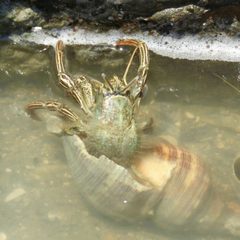
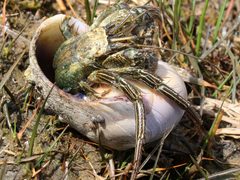
Clibanarius vittatus is a marine hermit crab in the Diogenidae, commonly known as the thinstripe or striped-legged hermit crab. It inhabits shallow coastal waters of the western Atlantic Ocean, including the Caribbean Sea and Gulf of Mexico. The exhibits distinctive longitudinal stripes on its legs and occupies empty gastropod shells for protection. Research has documented complex including sex-specific shell switching patterns during , risk-sensitive responses to threats, and size-dependent aggressive interactions.
Pronunciation
How to pronounce Clibanarius vittatus: /ˌklɪb.əˈnɛə.ri.əs ˈvɪt.ə.təs/
These audio files are automatically generated. While they are not always 100% accurate, they are a good starting point.
Identification
Distinguished from the sympatric Clibanarius sclopetarius by differences in , chela ornamentation, and coloration of eyestalks and antennal peduncle. legs display characteristic longitudinal striping pattern. Genetic divergence from C. sclopetarius ranges 4.5–5.9% for 16S rDNA and 9.4–11.9% for COI, supporting -level separation. from Brazil and Gulf of Mexico show considerable genetic differentiation that may indicate cryptic diversity.
Images
Habitat
Marine intertidal and shallow subtidal environments. Occupies empty gastropod shells, with shell adequacy influencing microhabitat selection and .
Distribution
Western Atlantic Ocean including Caribbean Sea, Gulf of Mexico, and Atlantic coast from at least Florida to Brazil. Records from Sebastian Inlet, Florida; northern Indian River Lagoon, Florida; and Mississippi barrier islands.
Life Cycle
Larval development includes planktonic stages with temporal patterns in hatching documented. is affected by shell size and coil orientation in females.
Behavior
Males increase shell switching during reproductive season to obtain larger shells that facilitate mating, despite elevated risk. Females show reduced shell switching during reproductive periods. Both sexes exhibit risk-sensitive behavior, adjusting activity levels based on perceived predation risk. Aggressive behavior is size-dependent: larger individuals are ; crabs in undersized shells show increased aggression; crabs in oversized shells show decreased aggression and are more easily displaced. Presence of empty shells reduces frequency of aggressive encounters. Courting males continue pre-copulatory behaviors when exposed to odors, though fewer pairs are established; females exposed to predator cues become unattractive to males.
Human Relevance
Used as a model organism in environmental toxicology studies, particularly for investigating effects of tributyltin (TBT) on . TBT exposure causes ovarian disorganization and in females, with potential -level impacts in harbors despite worldwide TBT ban.
Similar Taxa
- Clibanarius sclopetariusSympatric western Atlantic formerly considered for synonymization; distinguished by molecular divergence (4.5–5.9% 16S, 9.4–11.9% COI), , chela ornamentation, and eyestalk/antennal peduncle coloration.
Sources and further reading
- BugGuide
- GBIF taxonomy match
- iNaturalist taxon
- NCBI Taxonomy
- Catalogue of Life
- Forgotten Foto Friday: Centruroides vittatus | Beetles In The Bush
- Rare frog rediscovered after 130 years | Blog
- A face only a mother could love | Beetles In The Bush
- Marine invertebrates with Cornwall Wildlife Trust - Buglife Blog - Buglife
- Predation–Reproduction Conflict Resolution in the Hermit Crab, Clibanarius vittatus
- Size Relationships and Aggressive Behavior in the Hermit Crab Clibanarius vittatus
- Shell dynamics and microhabitat selection by striped legged hermit crabs, Clibanarius vittatus (Bosc)
- Stimuli Involved in the Feeding Behavior of the Hermit Crab Clibanarius Vittatus (Decapoda, Paguridea)
- Invertebrates Associated with the Thinstripe Hermit Clibanarius vittatus (Bosc) (Crustacea: Decapoda: Diogenidae) from the Barrier Islands of Mississippi
- POPULATION ECOLOGY OF THE HERMIT CRAB CLIBANARIUS VITTATUS (DECAPODA: DIOGENIDAE) AT SEBASTIAN INLET, FLORIDA
- Molecular barcode and morphological analyses reveal the taxonomic and biogeographical status of the striped-legged hermit crab species Clibanarius sclopetarius (Herbst, 1796) and Clibanarius vittatus (Bosc, 1802) (Decapoda : Diogenidae)
- Site specific constraints on shell selection behavior in the hermit crab,Clibanarius vittatus
- Population Ecology of the Hermit Crab Clibanarius vittatus (Decapoda: Diogenidae) at Sebastian Inlet, Florida
- Distribution of the Hermit Crabs Clibanarius vittatus and Pagurus maclaughlinae in the Northern Indian River Lagoon, Florida: A Reassessment After 30 Years
- The effects of shell size and coil orientation on reproduction in female hermit crabs, Clibanarius vittatus
- Effects of tributyltin exposure in hermit crabs:Clibanarius vittatusas a model
- Larval release behaviors of the striped hermit crab, Clibanarius vittatus (Bosc): Temporal pattern in hatching