
Pseudogarypidae
Chamberlin, 1923
Pseudogarypid Pseudoscorpions
Genus Guides
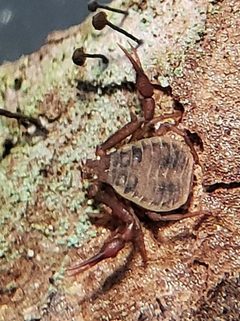
1Pseudogarypidae is a small of pseudoscorpions within the superfamily Feaelloidea. The family comprises two extant —Pseudogarypus and Neopseudogarypus—with most recent distributed in western North America. A single extant species, Neopseudogarypus scutellatus, is to Tasmania, representing a notable disjunct distribution. The family also includes several fossil species preserved in Baltic amber from the Eocene.
Pronunciation
How to pronounce Pseudogarypidae: /ˌsjuːdoʊˈɡɛrəˌpaɪdiː/
These audio files are automatically generated. While they are not always 100% accurate, they are a good starting point.
Identification
Members of Pseudogarypidae can be distinguished from other pseudoscorpion by characters of the chelal and trichobothrial patterns. The Pseudogarypus is characterized by distinctive morphological features of the chelae and that separate it from Neopseudogarypus. Specific identification requires examination of detailed chelal tooth counts and arrangement, as well as trichobothrial positions on the chelal fingers.
Images
Habitat
Extant occupy diverse microhabitats including caves (Pseudogarypus spelaeus, P. hypogeus), soil litter, and rocky substrates in forested and mountainous regions. The Tasmanian species Neopseudogarypus scutellatus has been recorded from soil and litter . Several species show association with subterranean environments.
Distribution
Recent are primarily distributed in western North America (California, Oregon, Washington, Arizona) with disjunct occurrences in the northeastern United States (Quebec) and Tasmania. Fossil species are known exclusively from Baltic amber deposits in northern Europe.
Similar Taxa
- Feaelloidea (other families)Other in the superfamily Feaelloidea (Feaellidae, Tyrannochthoniidae) share the suborder Atoposphyronida but differ in chelal patterns, trichobothrial arrangements, and geographic distribution.
- CheliferidaeMembers of this widespread pseudoscorpion may resemble Pseudogarypidae in general form but differ in trichobothrial patterns and typically have different chelal tooth formulae.
More Details
Fossil Record
The has an exceptionally well-documented fossil record for pseudoscorpions, with five named from Baltic amber (Eocene, approximately 48-34 million years ago). These fossils demonstrate morphological stability over tens of millions of years. Pseudogarypus synchrotron was described using synchrotron X-ray tomography, representing advanced imaging techniques for amber inclusions.
Biogeographic Significance
The disjunct distribution—western North America, Tasmania, and European fossils—suggests ancient vicariance or events. The Tasmanian represents the only extant Southern Hemisphere occurrence of the , likely a relictual distribution.