
Cryptomaster leviathan
Briggs, 1969
Leviathan harvestman
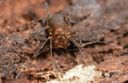
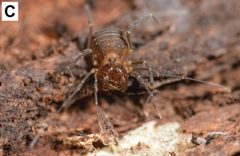
Cryptomaster leviathan is a harvestman (opilionid arachnid) from southeastern Oregon, described in 1969. It is notable for its relatively large body size compared to other travunioid Laniatores, which inspired its name referencing the biblical Leviathan. The was the sole member of its until the 2016 discovery of its C. behemoth. show surprisingly low genetic divergence across an expanded range spanning multiple mountain ranges.
Pronunciation
How to pronounce Cryptomaster leviathan: /ˌkrɪptoʊˈmæstər lɪˈvaɪəθən/
These audio files are automatically generated. While they are not always 100% accurate, they are a good starting point.
Identification
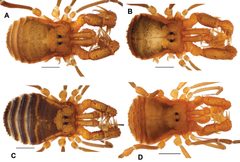
Distinguished from its Cryptomaster behemoth by genetic and geographic criteria; C. leviathan shows low across its expanded range while C. behemoth occupies a more restricted range with higher genetic variation. Both exhibit two size morphs (smaller and larger forms) that are not genetically differentiated. As a travunioid Laniatores, it has relatively short legs compared to other harvestmen.
Images
Habitat
Found in mature coniferous or mixed coniferous-hardwood forests, but also occurs in disturbed forests and forests with few conifers. Typically located under decaying logs and stumps, and in leaf litter of maple trees and Polystichum ferns.
Distribution
Southeastern Oregon, USA. Range expanded across multiple mountain ranges following recent survey work.
Behavior
Hides under logs, stones, and leaf litter. Two size morphs observed in both males and females across all known localities, but these forms are not genetically distinct.
Similar Taxa
- Cryptomaster behemothCongeneric discovered in 2016 from southwest Oregon; distinguished by more restricted geographic range and higher genetic variation despite smaller distribution
More Details
Etymology
Named after the Leviathan of the Book of Job in the Hebrew Bible, referencing its large body size relative to other travunioid Laniatores
Research history
established in 1969 and remained for nearly 50 years until discovery of C. behemoth in 2016; recent work expanded known localities and revealed low between