
Caddidae
Banks, 1893
Large-eyed Harvestmen
Genus Guides
1Caddidae is a of harvestmen arachnids and the sole family in the superfamily Caddoidea. The family contains only two extant in the Caddo, following taxonomic revision that removed previously included genera to other families. These tiny harvestmen have body lengths of 1–3 mm and exhibit a disjunct distribution across eastern North America and East Asia.
Pronunciation
How to pronounce Caddidae: /ˈkadɪˌdiː/
These audio files are automatically generated. While they are not always 100% accurate, they are a good starting point.
Identification
Distinguished from other Eupnoi by their minute size (1–3 mm body length) and phylogenetic placement. The Caddo is the only extant genus in the family following removal of Acropsopilio, Austropsopilio, Caddella, and Hesperopilio to other families or uncertain placement. Specific identification requires examination of palpal and genital .
Images
Appearance
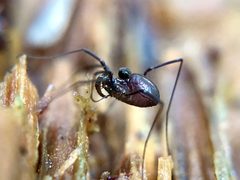
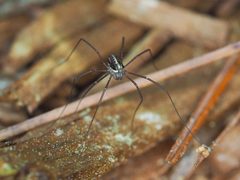
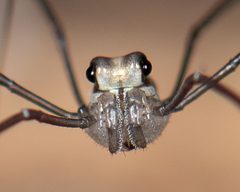
Body length between 1 and 3 mm. As harvestmen, they possess a prosoma and opisthosoma without a narrow waist, and characteristically long, slender legs relative to body size.
Distribution
Disjunct distribution: eastern North America (USA, Canada) and East Asia (Japan, South Korea, Russian Far East including Primorskii Krai and Kuril Islands). The northwestern boundary in Asia is Primorskii Krai, Russia.
Human Relevance
The name derives from "Caddo," a North American culture, people, and language.
Similar Taxa
- AcropsopilionidaePreviously included in a wider concept of Caddidae; restored to separate status and placed in suborder Dyspnoi rather than Eupnoi.
- NemastomatidaeAnother of small-bodied Dyspnoi harvestmen; Caddidae is distinguished by its placement in Eupnoi and unique phylogenetic position.
Misconceptions
Historical treatments included many more (Acropsopilio, Austropsopilio, Caddella, Hesperopilio) under a broad concept of Caddidae. These have been removed based on phylogenetic studies, reducing Caddidae to a single genus with two extant .
More Details
Taxonomic history
The underwent significant revision after Shear (1974). Previously grouped with Gondwanan distributions (South America, Australia, New Zealand, southern Africa) have been transferred to other families or remain of uncertain placement, fundamentally altering biogeographic interpretations.
Phylogenetic divergence
Caddo agilis and C. pepperella diverged phylogenetically before acquiring their current disjunct, sympatric distributions in Japan and North America, indicating that their geographic pattern resulted from rather than vicariance alone.
Sources and further reading
- BugGuide
- Wikipedia
- GBIF taxonomy match
- iNaturalist taxon
- NCBI Taxonomy
- Catalogue of Life
- On northwestern distribution of the family Caddidae (Opiliones) in Asia
- New records of Acropsopilio neozealandiae (Forster), and remarks on the sexual status of the species (Arachnida: Opiliones: Caddidae)
- Caddo agilis and C. pepperella (Opiliones, Caddidae) diverged phylogenetically before acquiring their disjunct, sympatric distributions in Japan and North America