
Theridiosoma gemmosum
(L. Koch, 1877)
Common Eastern Ray Spider, Ray Spider
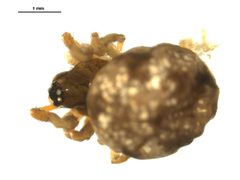
A small Holarctic ray spider distinguished by its unique conical orb web. Females measure 2–3 mm, males 1.5–2 mm. The constructs a specialized web held under tension by the spider, which is released to snap forward and capture flying prey. Mating involves successive copulations with males providing silk draglines that females ingest as between copulations.

Pronunciation
How to pronounce Theridiosoma gemmosum: /ˌθɛrɪdiəˈsoʊmə ˈdʒɛməsəm/
These audio files are automatically generated. While they are not always 100% accurate, they are a good starting point.
Identification
Distinguished from other small orb-weaving spiders by its conical web structure and the unique mechanism of releasing the web to capture prey. The globular silvery and small size separate it from larger orb-weavers. Male palpal bulbs and female epigyne provide definitive identification. Similar to other Theridiosomatidae but separated by geographic range and specific genitalic .
Images
Appearance
Small spider with females 2–3 mm, males 1.5–2 mm. dark brown. globular, shiny, silvery on upper surface with variable dark lines and marks. Male palpal bulbs and female epigyne distinctive for identification.
Habitat
Damp among low-growing vegetation. Found in mesic forests, riparian corridors, and areas with sufficient moisture to support vegetation where webs can be anchored.
Distribution
Holarctic distribution throughout northern and central parts of the Northern Hemisphere. Recorded from North America, Europe, Turkey, Caucasus, Iran, Japan, and Britain. Described as rare in northern Europe including Great Britain and Ireland. First recorded in Romania in 2024.
Diet
Captures flying insects, particularly mosquitoes, using its conical orb web.
Behavior
Constructs a small conical orb web with joined into groups of two or three before meeting at the center. Holds a single tension thread connecting the web center to a nearby support, pulling the web into a conical shape. Releases the thread when prey approaches, allowing the web to snap forward and capture the insect. Has been observed to release the web in response to specific sound frequencies, suggesting auditory detection of prey. Mating involves successive copulations; between copulations, females unwind and ingest male dragline silk as a .
Ecological Role
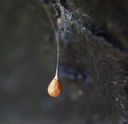
of small flying insects. sacs subject to attack, indicating role in supporting parasitoid .
Similar Taxa
- Naatlo spp.Also Theridiosomatidae with slingshot web mechanism, but Neotropical distribution versus Holarctic for T. gemmosum
- Other Theridiosoma speciesRequire examination of genitalia for definitive separation; T. gemmosum is the most widespread Holarctic member of the
Sources and further reading
- BugGuide
- Wikipedia
- GBIF taxonomy match
- iNaturalist taxon
- NCBI Taxonomy
- Catalogue of Life
- Botanizing at Meramec State Park, Natural Wonders Trail | Beetles In The Bush
- Theridiosomatidae Archives - Entomology Today
- Bug Eric: Bridge Orbweaver (Gray Cross Spider)
- Bug Eric: Aculepeira Orb Weavers
- How I Discovered a South American Slingshot Spider
- First record of Theridiosoma gemmosum (Araneae, Theridiosomatidae) in the Romanian fauna
- Who wins? Ray spiders (Theridiosoma gemmosum) (Araneae: Theridiosomatidae) versus egg sac parasitoids
- Mating behavior of Theridiosoma gemmosum (araneae: Theridiosomatidae): The unusual role of the male dragline silk