
Theridiosomatidae
Simon, 1881
ray orbweavers, ray spiders, slingshot spiders
Genus Guides
1- Theridiosoma(ray spiders)
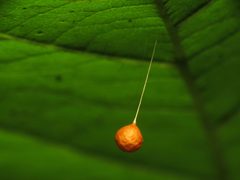
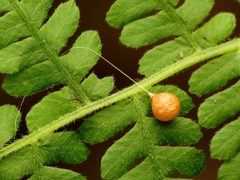
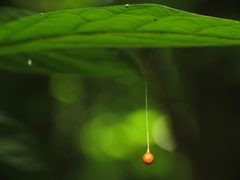
Theridiosomatidae is a small of orb-weaving spiders known for constructing distinctive cone-shaped or slingshot webs. The family comprises approximately 137 extant in 20 , distributed primarily in tropical and subtropical regions worldwide. Members are commonly called "ray spiders" or "slingshot spiders" due to their unique web architecture where the web center is pulled back and anchored, then released to propel the spider toward prey. Most species are small, typically under 1 cm in body length. The family exhibits remarkable behavioral diversity in web construction, with some genera showing specialized adaptations including cave-dwelling and high-elevation preferences.
Pronunciation
How to pronounce Theridiosomatidae: /ˌθɛrɪˌdiːoʊˌsoʊməˈtaɪdiː/
These audio files are automatically generated. While they are not always 100% accurate, they are a good starting point.
Identification
Theridiosomatidae spiders are distinguished from other orb-weaving by their characteristic cone-shaped or ray-formed webs, where the web center is pulled back into a cone rather than lying flat. The family includes small-bodied spiders, with most measuring under 10 mm; Simonia species range 1.50–1.65 mm (males) and 1.90–2.45 mm (females). Morphological identification to requires examination of genitalia: male palps often feature distinctive embolic structures (torch-shaped in Simonia), and female epigynes show characteristic surface patterns and copulatory bursae. The web architecture itself serves as a field diagnostic when observable.
Images
Habitat
Tropical and subtropical forests constitute the primary , with occupying diverse microhabitats from lowland swamps to high-elevation meadows. Several show habitat specialization: Sennin is troglophilic (cave-dwelling), with species known from limestone caves; Aculepeira species occur at high elevations and latitudes, including montane forests above 2,500 meters; Wendilgarda builds webs on running water surfaces. Some species occupy artificial structures near water bodies.
Distribution
Global distribution concentrated in tropical and subtropical regions. Neotropical: Amazon basin, Central and South America (including slingshot spiders in Peru). Oriental: Southeast Asia including Laos, Vietnam, southern China, Sumatra (Indonesia), and the Ryukyu Islands (Japan). Palearctic: Europe, Siberia, northern China, Russian Far East; recently recorded in Romania. Nearctic: Alaska, Yukon, northern Mexico, with disjunct in northeastern United States.
Diet
Flying insects constitute the primary prey. Observations document capture of mosquitoes and other small aerial insects. Some exploit abundant emerging aquatic insects (, mayflies) near water bodies. Species near artificial lights capture phototactic insects drawn to illumination.
Life Cycle
with internal ; detailed copulatory organ described for multiple . sacs produced, subject to attack (documented in Theridiosoma gemmosum). specimens observed occupying web hubs during daytime more frequently than mature individuals.
Behavior
The exhibits highly specialized web-building : spiders construct cone-shaped webs by pulling the center back and anchoring it to vegetation, then releasing tension to slingshot themselves toward prey. This "ray" or "slingshot" mechanism allows active prey capture rather than passive entanglement. Spiders typically occupy web hubs at night or during overcast conditions, retreating to web periphery during daylight. Wendilgarda build on water surfaces. Web reconstruction occurs nocturnally. Some species demonstrate rapid web-resetting behavior after missed strikes.
Ecological Role
of small flying insects in tropical and subtropical . Near water bodies, they function as significant consumers of emerging aquatic insects, potentially influencing aquatic-terrestrial subsidies. sac exploit the as , indicating their integration into dynamics.
Human Relevance
Slingshot spider has generated substantial public and scientific interest, with observation videos viewed hundreds of thousands of times. Some occupy urban environments near water bodies and artificial lighting, facilitating human encounters. No medically significant bites documented.
Similar Taxa
- AraneidaeBoth construct orb webs; Araneidae webs are flat, circular, and passive, while Theridiosomatidae webs are conical with active slingshot mechanism. Araneidae are generally larger with different abdominal patterning.
- TetragnathidaeBoth are orb-weaving with elongated body forms in some ; Tetragnathidae construct horizontal or inclined orb webs without the conical tension structure, and typically have more pronounced cheliceral elongation.
Sources and further reading
- BugGuide
- GBIF taxonomy match
- iNaturalist taxon
- NCBI Taxonomy
- Catalogue of Life
- Theridiosomatidae Archives - Entomology Today
- Bug Eric: Bridge Orbweaver (Gray Cross Spider)
- Bug Eric: Aculepeira Orb Weavers
- How I Discovered a South American Slingshot Spider
- First record of Theridiosoma gemmosum (Araneae, Theridiosomatidae) in the Romanian fauna
- Who wins? Ray spiders (Theridiosoma gemmosum) (Araneae: Theridiosomatidae) versus egg sac parasitoids
- Simonia gen. nov., a new spider genus (Araneae, Theridiosomatidae) from Southeast Asia
- Two new species and a new genus of ray spiders (Araneae, Theridiosomatidae) from the Ryukyu Islands, southwest Japan, with notes on their natural history
- A review of the spider genus Sinoalaria (Araneae, Theridiosomatidae), with the descriptions of four new species and two new combinations
- Three new species of the genus Coddingtonia from Asia (Araneae, Theridiosomatidae)
- The web structure and the predatory behavior of Wendilgarda sp.(Araneae: Theridiosomatidae).
- Description of two new spider species from Ecuadorian caves, along with a note on the distribution of Plato troglodita Coddington, 1986 (Araneae, Theridiosomatidae)
- Breaking the mold: behavioral variation and evolutionary innovation inWendilgardaspiders (Araneae Theridiosomatidae)
- The web-building behavior and predatory behavior of Theridiosoma epeiroides BÖSENBERG et STRAND (Araneae: Theridiosomatidae) and the origin of the ray-formed web
- Observations on the Web and Behavior of Wendilgarda Spiders (Araneae: Theridiosomatidae)
- Taxonomic revenabled 12-06-24ision of the orb weaving spider genus Plato Coddington, 1986 (Araneae: Theridiosomatidae) with the description of three new species
- A review of the spider genus Chthonopes (Araneae, Theridiosomatidae), with descriptions of two new species from China