Tidarren
Chamberlin & Ivie, 1934
Species Guides
2- Tidarren haemorrhoidale
- Tidarren sisyphoides(Tent Cobweb Weaver)
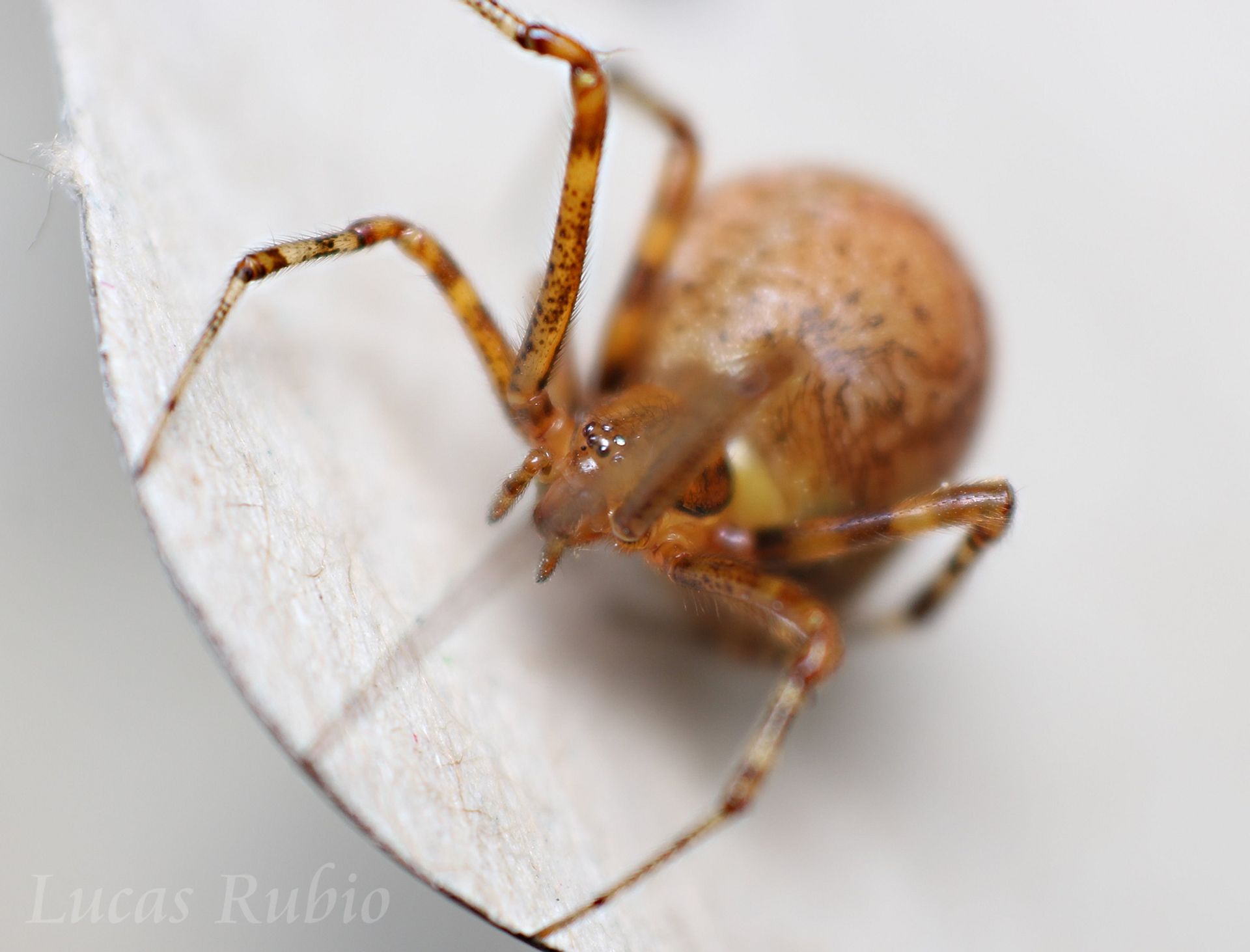
A of tangle-web spiders (Theridiidae) characterized by extreme sexual size dimorphism and remarkable male reproductive . Males are dwarfed (approximately 1 mm) compared to females (approximately 3 mm). Males voluntarily amputate one of their two (copulatory organs) before their final , entering adulthood with a single functional palp. This self-amputation is achieved by the male raising one palp and circling until it becomes entangled and constricted by silk threads. In at least one (T. argo), the female tears off the remaining palp during mating, which then continues to function as a mating plug for several hours while she consumes the male. These represent some of the most extreme examples of sexual and emasculation documented in spiders.
Pronunciation
How to pronounce Tidarren: //tɪˈdærɛn//
These audio files are automatically generated. While they are not always 100% accurate, they are a good starting point.
Identification
Females are medium-sized theridiids approximately 3 mm in body length with longer than wide, concave , and recessed region. is higher than long, often bearing a , sometimes with white lateral lines and a white aboral stripe extending from apex to . Males are dramatically smaller dwarfs approximately 1 mm in length with high clypeus and protruding eye region. males possess only one due to pre-maturation self-amputation. Male stridulatory organ present on border of prosoma but inconspicuous. Leg formula 1423. Sternum sometimes shows characteristic patterning.
Images
Habitat
Constructs webs consisting of a retreat and a scaffold of threads extending from a wall surface, rarely or never reaching ground level. Web dimensions vary with available space; large female webs in field conditions may reach up to half a meter in height. Retreat is a densely spun area incorporating prey remnants and debris.
Distribution
occurs in Africa, Yemen, and other regions; regular occurrence in Africa suggests additional may be currently classified under the collective genus Theridion.
Diet
Euryphagous . Tidarren haemorrhoidale has been documented consuming Opiliones, Diplopoda, and at least eight orders of insects, with ants comprising a significant portion of prey. Individual spiders exhibit diet specialization for prey size and taxonomic identity, though this specialization does not correlate with spatial distribution of prey types.
Life Cycle
Males undergo self-amputation of one a few hours after the (final ) . This is accomplished by raising one palp and circling until it becomes caught in silk threads at the molting site, with continued circling causing constriction and eventual detachment. Males generally die during mating.
Behavior
Males construct a mating thread during courtship, plucking it rhythmically until the female approaches; copulation occurs on this thread. In T. argo, the female tears off the male's single remaining palp upon genital coupling; the detached palp remains attached to the female epigyne for approximately four hours and continues to function independently as a mating plug. The female feeds on the emasculated male during this period. In T. cuneolatum, males are devoured within minutes of insertion.
Ecological Role
with individual diet specialization; may contribute to local through on diverse prey including ants, millipedes, and harvestmen.
Similar Taxa
- EchinotheridionShares male sexual organ removal (amputation of one before maturation), extreme sexual size dimorphism, and sexual . However, phylogenetic analyses indicate these similarities likely represent rather than shared ancestry; the two are closely related but not sister .
- TheridionAfrican Tidarren may be under-represented in collections due to small male size, with some specimens possibly misidentified or listed under this large collective .
Sources and further reading
- BugGuide
- Wikipedia
- GBIF taxonomy match
- iNaturalist taxon
- NCBI Taxonomy
- Catalogue of Life
- Individual diet specialization in the spider Tidarren haemorrhoidale (Bertkau, 1880) (Theridiidae)
- Phylogenetic placement of Echinotheridion (Araneae : Theridiidae) – do male sexual organ removal, emasculation, and sexual cannibalism in Echinotheridion and Tidarren represent evolutionary replicas?
- Tidarren argo sp. nov. (Araneae: Theridiidae) and its exceptional copulatory behaviour: emasculation, male palpal organ as a mating plug and sexual cannibalism