
Tidarren sisyphoides
(Walckenaer, 1841)
Tent Cobweb Weaver
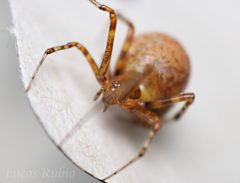
Tidarren sisyphoides is a tangle web spider ( Theridiidae) known for extreme sexual size dimorphism, with males approximately 10% the size of females. The exhibits a rare mating system in which males die during copulation and remain attached to females for over two hours, though females do not practice sexual . It constructs a distinctive three-dimensional web with a dome-shaped sheet and upper tangle that functions as the primary prey capture structure.
Pronunciation
How to pronounce Tidarren sisyphoides: //tɪˈdɑːrɛn ˌsɪsəˈfɔɪdiːz//
These audio files are automatically generated. While they are not always 100% accurate, they are a good starting point.
Identification
Distinguished from other Theridiidae by the combination of: (1) extreme male dwarfism relative to females; (2) web architecture featuring a dome-shaped sheet with upper tangle; and (3) geographic range in the southern United States through northern South America. Horizontal sheet components are relatively sparse compared to the dense dome structure. Viscous threads with hydrophilic glue balls are present and increase in size when wet.
Images
Appearance
Males are dramatically smaller than females, approximately 10% of female body mass. Average female body mass is about 51.8 mg. measure approximately 0.66 mm in diameter.
Habitat
Web-building spider occupying environments where three-dimensional web architecture can be constructed. Specific microhabitat preferences not documented.
Distribution
Southern United States to Colombia, including the West Indies. Present in Middle America and the Caribbean. Records from Brazil (Rio de Janeiro, São Paulo) and Cundinamarca (Colombia).
Diet
Prey captured in viscous threads of the web; captured prey is moved to a retreat for additional wrapping and thread application. Specific prey not documented.
Life Cycle
Females produce clutches averaging approximately 238 . Egg diameter ~0.66 mm, mass ~0.16 mg. Developmental details beyond egg stage not documented.
Behavior
Web construction proceeds through three stages: scaffolding, doming, and web-filling. The dome-shaped sheet and upper tangle form the functional prey capture trap; horizontal sheets play a minor role. After prey capture, viscous threads are applied and prey is transported to a retreat for further wrapping. Females reject multiple copulations and physically remove additional males after mating.
Ecological Role
utilizing web-based prey capture. Web structure includes hydrophilic viscous balls that may function in prey retention under varying humidity conditions.
Similar Taxa
- Other Tidarren speciesShare -level characteristics including web architecture with dome-shaped sheets; T. sisyphoides distinguished by geographic range and specific mating system details
- Other TheridiidaeMany construct tangle webs; T. sisyphoides distinguished by the combination of extreme sexual size dimorphism, specific web construction stages, and non-cannibalistic mating system with male death during copulation
More Details
Mating system
Male death during copulation is not followed by sexual , representing a rare alternative to the cannibalistic mating systems common in related spiders. The male's reproductive organs remain attached to the female for an average of 2.4 hours post-mortem.
Etymology
Specific epithet derived from Sisyphos, a king in Greek mythology condemned to eternal repetitive labor, possibly alluding to web construction or the extended post-copulatory attachment.