
Argyrodes elevatus
Taczanowski, 1873
dew-drop spider, American Dewdrop Spider
Argyrodes elevatus is a kleptoparasitic spider in the Theridiidae that steals food from the webs of other spiders rather than building its own. measure 4–7 mm in length, with males smaller than females. The exhibits specialized adaptations for stealth, including vibrational detection of activity, rapid prey theft completed in under 12 seconds, and activity patterns that oppose those of host species. Courtship involves males presenting silk-wrapped prey as to females.
Pronunciation
How to pronounce Argyrodes elevatus: /ˌaɹ.d͡ʒəˈɹoʊ.diːz ˌɛ.ləˈvɑː.təs/
These audio files are automatically generated. While they are not always 100% accurate, they are a good starting point.
Identification
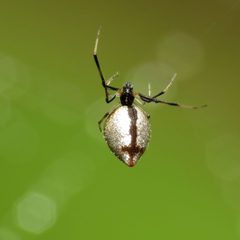
Distinguished from other Argyrodes by its association with orb-weaving (Argiope, Nephila, Metepeira) and specific kleptoparasitic . The silver, bulbous with dark longitudinal line is visually distinctive. Males identified by modified . Differentiated from free-living Theridiidae by presence in foreign webs and lack of web-building behavior.
Images
Appearance
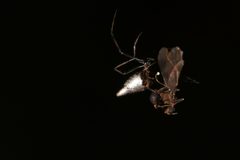
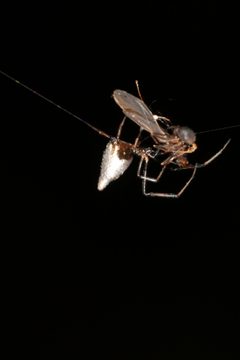
Small spider with body length of 4–7 mm. dark brown to black; legs lighter brown with darker tips. silver, bulb-like, and conical with a dark longitudinal line. Males smaller than females with lower, upward-pointing abdomen.
Habitat
Found in the webs of spiders in tropical and subtropical regions. Does not construct its own web. Occupies outer regions of host webs, particularly those of orb-weaving spiders in open, vegetation-rich areas.
Distribution
Central America, South America, and southern United States (California, Texas, Florida, Virginia). Large reported in Trinidad.
Diet
Primarily food stolen from spider webs: wrapped insect prey, host sacs, and web silk. Occasionally shares prey with host at web hub. Juveniles have been observed feeding on host spiders when prey availability is low and size difference is minimal.
Host Associations
- Argiope argentata - kleptoparasiteOrb-weaving ; A. elevatus evades detection due to host's poor vision and non-triggering vibrations
- Nephila clavipes - kleptoparasiteGolden orb-weaver
- Metepeira incrassata - kleptoparasiteMexican orb-weaver; colonial webs may up to 45 A. elevatus individuals
- Idris wasp species (Platygastridae) - Endoparasitoids of A. elevatus ; two described from Brazil
Life Cycle
laid on outer regions of web approximately 24 hours after copulation. One to two eggs per clutch. Eggs embedded on thread structures without parental protection.
Behavior
Highly specialized kleptoparasite with two main theft strategies: (1) raiding hub immediately after wraps prey and departs, or (2) waiting for multiple prey to accumulate before raiding. Uses vibrational detection via spread front legs tapping threads, enhanced by self-laid detection threads along web . Cuts host web threads to detach prey, following pre-laid escape threads to retreat. Thefts typically completed in under 12 seconds with approximately 67% success rate. activity pattern opposes hosts; monitors host activity through web vibrations. Males court females with distinct vibrational signals while carrying silk-wrapped prey as on .
Ecological Role
Kleptoparasite that reduces prey availability for spiders. May influence host web relocation frequency and weight gain. Web silk consumption may contribute to nutrient cycling in web-based .
Human Relevance
Subject of behavioral research due to specialized kleptoparasitic adaptations. Observations of - interactions contribute to understanding of social and foraging .
Similar Taxa
- Argyrodes antipodianusSimilar kleptoparasitic and ; distinguished by geographic distribution and associations
- Argyrodes trigonumCongeneric kleptoparasite; differs in specific associations and geographic range
- Other TheridiidaeFree-living web-building ; distinguished by A. elevatus's presence in foreign webs, lack of web construction, and specialized theft
More Details
Chemical communication
Cuticular extracts contain novel methyl-branched long-chain esters showing striking , suggesting role in chemical communication, though behavioral function not yet confirmed.
Web silk consumption
Consumes web silk as supplementary food source, particularly during periods of low prey-theft success; cuts up to 4 cm of host web threads during prey removal.
Sources and further reading
- BugGuide
- Wikipedia
- GBIF taxonomy match
- iNaturalist taxon
- NCBI Taxonomy
- Catalogue of Life
- Bug Eric: Spider Sunday: Dewdrop Spiders
- Behaviour of the kleptoparasitic spider Argyrodes elevatus (Araneae, theridiidae)
- Identification and Synthesis of Branched Wax‐type Esters, Novel Surface Lipids from the SpiderArgyrodes elevatus(Araneae: Theridiidae)
- Two new species of Idris Foerster (Hymenoptera: Platygastridae) from Southeastern Brazil parasitoids of Argyrodes elevatus Walckenaer (Araneae:Theridiidae) and Scytodes sp. (Araneae: Scytodidae)