
Olios giganteus
Keyserling, 1884
Giant Crab Spider
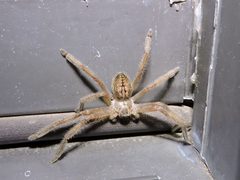
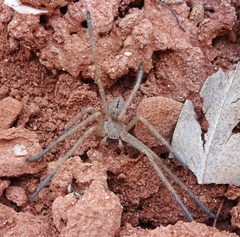
Olios giganteus is a large huntsman spider in the Sparassidae, native to the southwestern United States and Mexico. Females reach body lengths up to 48 mm with leg spans of 50–64 mm, making them among the largest spiders in North America. They are that use laterigrade legs to navigate vertical surfaces and squeeze into narrow crevices. Despite their size, they are harmless to humans.
Pronunciation
How to pronounce Olios giganteus: //ˈoʊliɔs d͡ʒɪˈɡæntiəs//
These audio files are automatically generated. While they are not always 100% accurate, they are a good starting point.
Identification
Distinguished from other large North American spiders by laterigrade legs that project sideways in crab-like fashion, flattened body profile, and extremely large size combined with harmless demeanor. Tarantulas ( Theraphosidae) have vertically oriented legs and ; wolf spiders (Lycosidae) lack laterigrade legs and have different arrangement. Other Olios in the region require expert examination for separation.
Images
Habitat
Dry mixed conifer forest with oaks at elevations around 7,000 feet; also found in desert and semi-arid environments. Frequently encountered on vertical surfaces including exterior walls of buildings, doorways, and under loose bark. Capable of navigating smooth artificial surfaces.
Distribution
Southwestern United States (California, Nevada, Utah, Arizona, New Mexico, extreme west Texas) and Sonora, Mexico. Records concentrated in arid and semi-arid regions of the American Southwest.
Seasonality
Active year-round in suitable climates; activity peaks in warmer months. One observation notes of approximately one month in mid-to-late summer.
Life Cycle
Females normally nomadic but become sedentary when gravid, constructing a large bag-like retreat within which they spin an sac. They guard the egg sac and emerging spiderlings throughout incubation, fasting during this period. Spiderlings emerge after approximately one month. Little else known about developmental stages or longevity.
Behavior
hunter that emerges at night to pursue prey. Highly agile climber capable of navigating smooth vertical surfaces and slender twigs using paired claws and specialized hairs. Hides by day in narrow crevices, beneath loose bark, or building crevices. Has been observed indoors, where they may remain for extended periods. One individual with seven legs (one missing) showed no apparent impairment in agility or climbing ability.
Ecological Role
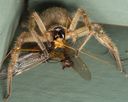
of insects and other arthropods; attracted to lights where insect prey congregate. May contribute to local suppression of pest insects including scorpions, based on anecdotal observation.
Human Relevance
Harmless to humans despite large size; occasionally enters buildings where they may be encountered on walls or doorways. Historical reports of newspaper publicity labeling them "barking spiders" in west Texas small towns. Sometimes mistaken for medically significant spiders due to size, causing unnecessary alarm.
Similar Taxa
- Olios fasciculatusFormerly applied to U.S. specimens now recognized as O. giganteus; African not naturally occurring in North America
- Tarantulas (Theraphosidae)Similar large size but have vertically oriented legs, , and different body proportions
- Wolf spiders (Lycosidae)Large active hunters but lack laterigrade legs and have characteristic arrangement with two large eyes
Misconceptions
Despite large size and imposing appearance, this is harmless to humans and does not possess medically significant venom. The name "barking spider" applied in some regions appears to be a misnomer or folk name without biological basis.
More Details
Sources and further reading
- BugGuide
- Wikipedia
- GBIF taxonomy match
- iNaturalist taxon
- NCBI Taxonomy
- Catalogue of Life
- Hissers: Big, Bold and Beautiful | Bug Squad
- UC Davis Picnic Day: Let's Go on an Insect Scavenger Hunt! | Bug Squad
- Bug Eric: Spider Sunday: Giant Crab Spider
- Bug Eric: New Mexico Night Bugs
- Big is Best but not for Bugs - Buglife Blog - Buglife
- tetrapods | Blog