Olios
Walckenaer, 1837
Golden Huntsman Spiders, Giant Crab Spiders, Huntsman Spiders
Species Guides
1- Olios giganteus(Giant Crab Spider)
Olios is the largest of huntsman spiders ( Sparassidae), with approximately 165-250 described distributed globally, primarily in tropical and subtropical regions. The genus was established by Walckenaer in 1837. Species range from small to large in size, with eight arranged in two partially straight rows. Many species are hunters that inhabit vegetation and occasionally enter human structures. The genus has undergone extensive taxonomic revision, with species organized into eight recognized species groups based on morphological characteristics.
Pronunciation
How to pronounce Olios: /ˈoʊ.li.oʊs/
These audio files are automatically generated. While they are not always 100% accurate, they are a good starting point.
Identification
Distinguished from other Sparassidae by arrangement (eight eyes in two partially straight rows) and male palpal used to define groups. The genus is divided into eight species groups (argelasius-, coenobitus-, auricomis-, correvoni-, rossettii-, nentwigi-, stimulator-, and hirtus-groups) based on detailed morphological characters. O. giganteus in North America was formerly misidentified as O. fasciculatus (an African species). Species-level identification requires examination of genitalia and other detailed morphological features.
Images
Appearance
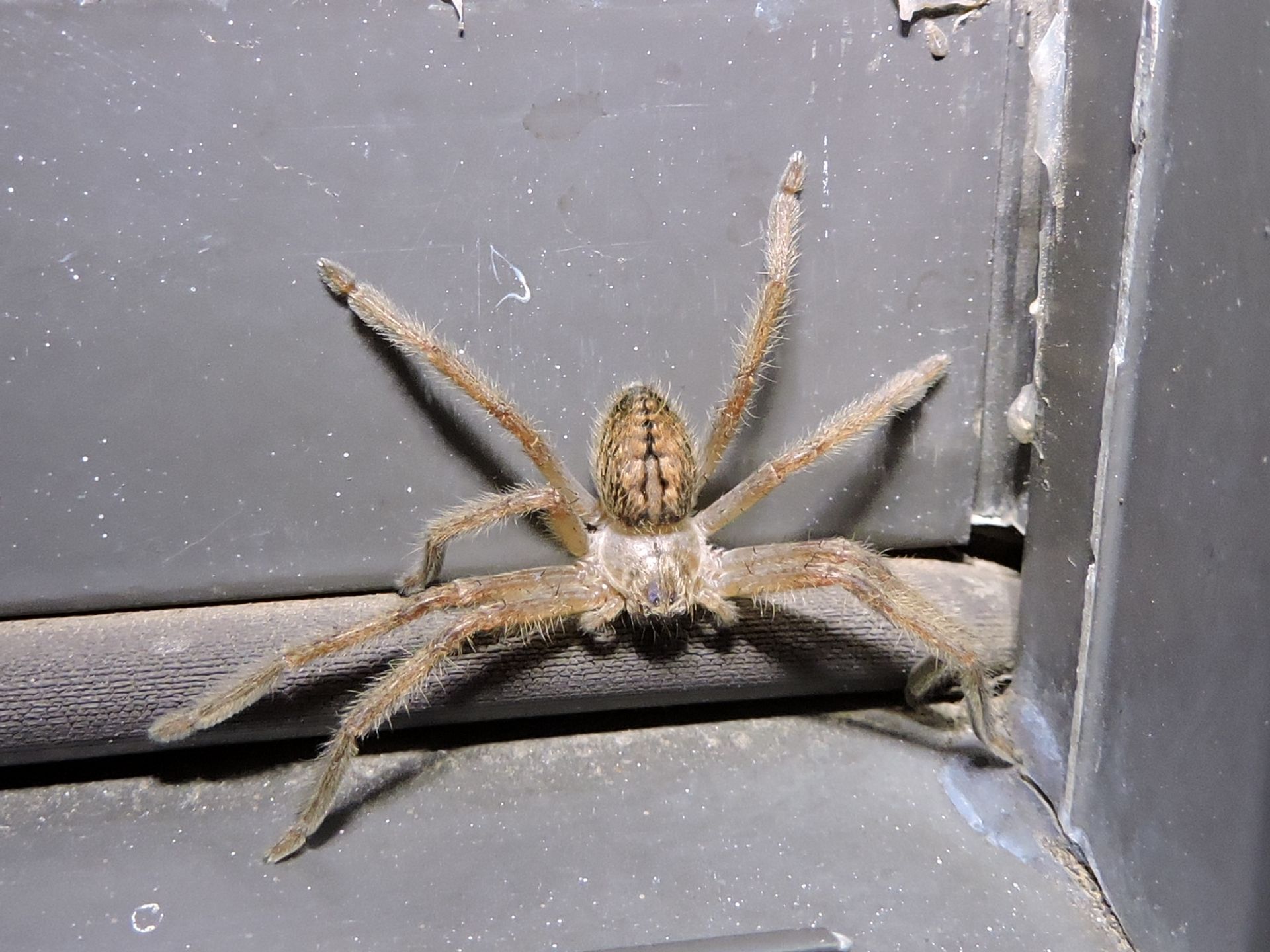
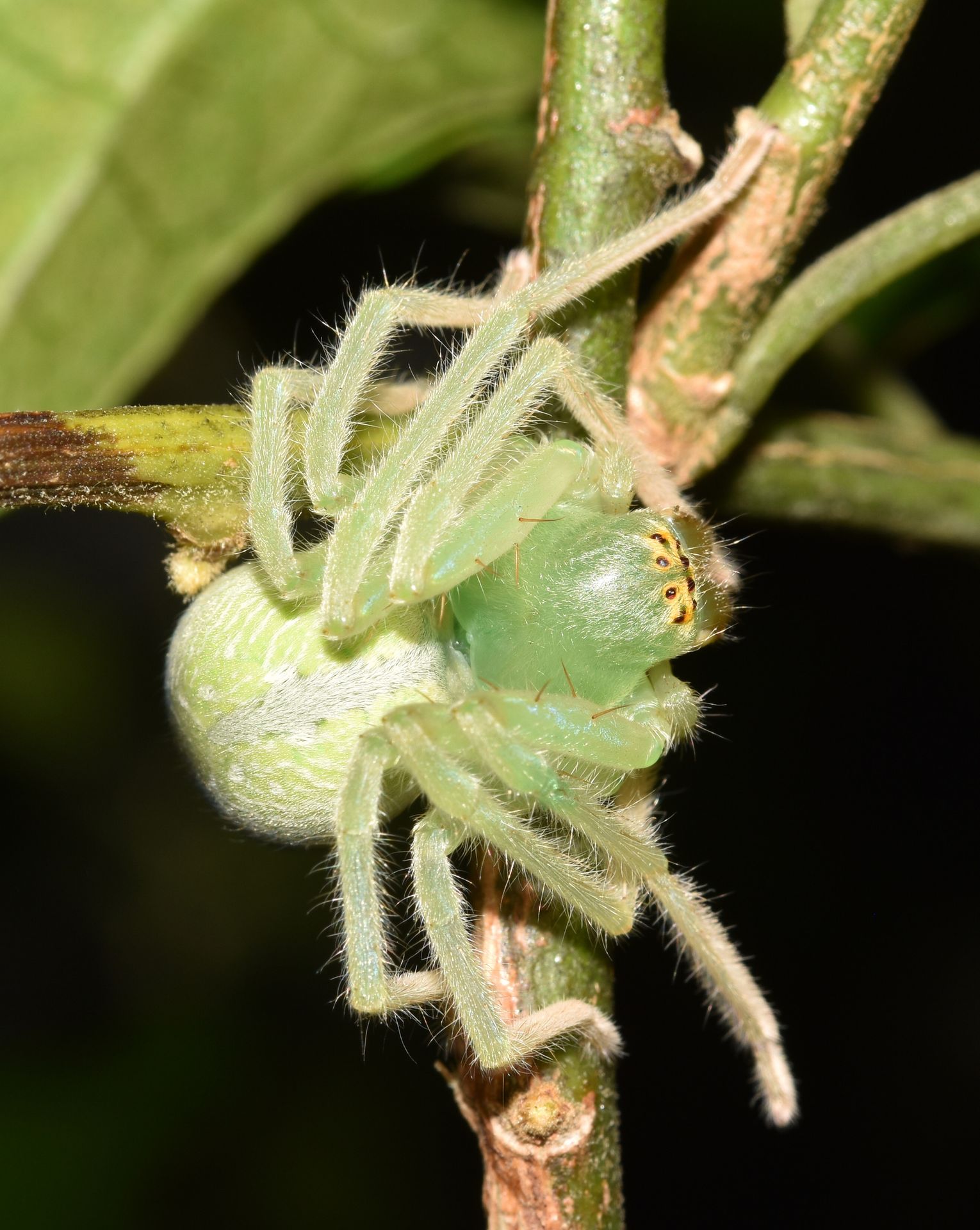
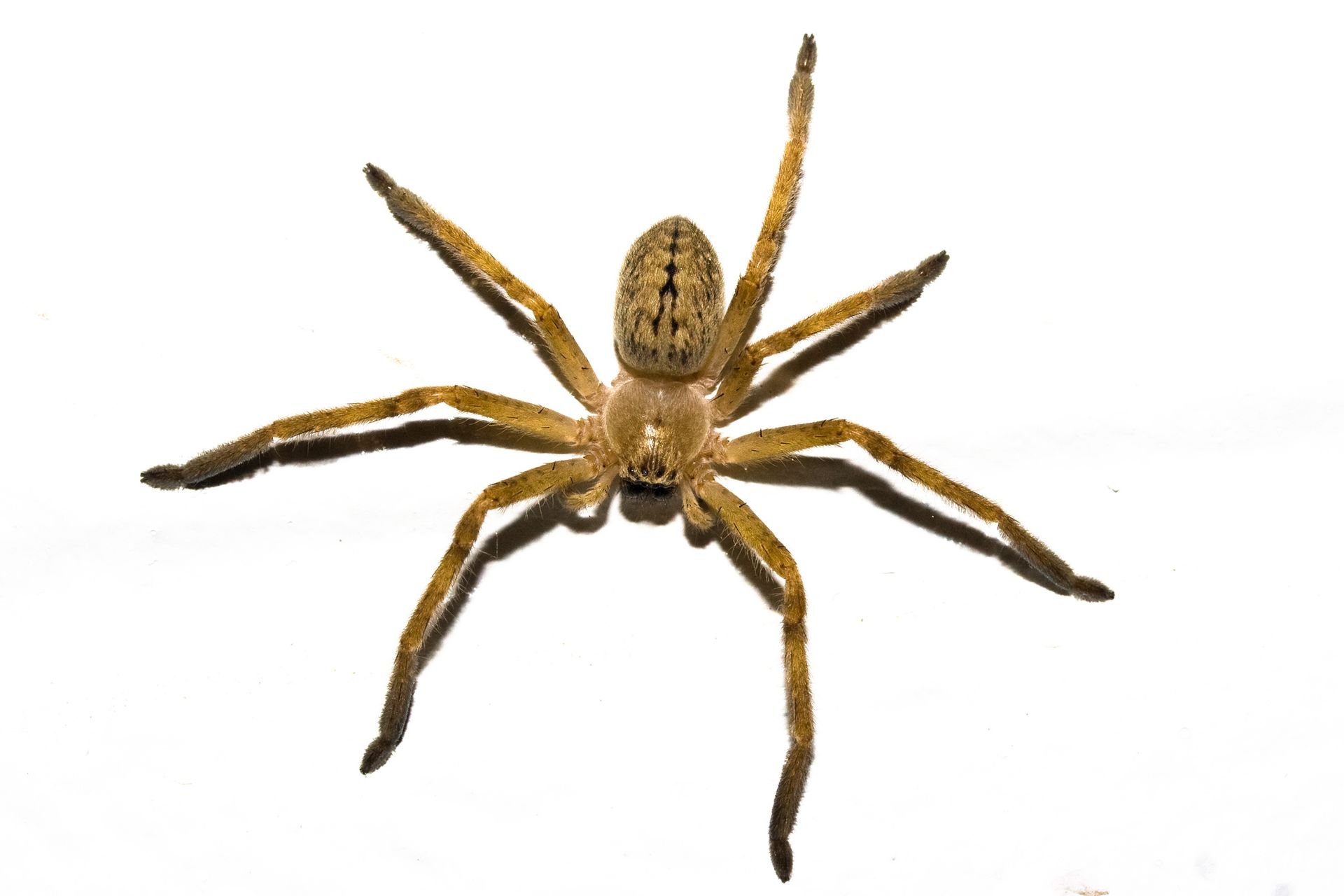
Small to large-bodied sparassid spiders with eight in two partially straight rows. Smaller typically light brown to brown with darker markings; larger species generally darker, with some members exhibiting green coloration. Legs are laterigrade (twisted at the base, oriented horizontally), allowing the flat body to enter narrow crevices. Paired claws at leg tips with tuft of special hairs between them enable navigation of textured surfaces. Body size varies considerably: O. giganteus females reach 14.6-48 mm body length (average 31.6 mm), males 11.3-29.4 mm (average 25 mm), with legspan 50-64 mm.
Habitat
Highly varied due to wide distribution: savannahs, rainforests, dry mixed conifer forests, parklands, and urban areas. Primarily found in vegetation including trees, under loose bark, and on vertical surfaces. Occasionally found in human structures. O. biprocessus collected under bark at 30m elevation; O. uniprocessus found in urban setting at 253m elevation; O. lincangensis from high-elevation mountain at 3428m. Rarely found in houses, though sometimes inadvertently transported with fruit shipments.
Distribution
Global distribution concentrated in tropical and subtropical regions. Primary regions: Africa (widespread including Mediterranean region, northern Africa, sub-Saharan Africa, Madagascar), southern Europe, Asia (Middle East, Central Asia, South Asia, East Asia, Southeast Asia, Indonesia, Philippines), and scattered occurrences in North America (southwestern U.S. from California to western Texas, introduced). Specific groups have more restricted ranges: argelasius-group (Mediterranean, northern Africa, Canary Islands, Middle East, South Sudan, East Africa, southern Africa); coenobitus-group (Gambia, Angola, Tanzania, Madagascar, India, Sri Lanka, Java); auricomis-group (Africa south of 10°N); rossettii-group (Mediterranean, eastern Africa, Asia from Middle East to Japan, Philippines, Java); nentwigi-group (Southeast Asia, China, Taiwan, Indonesia, Philippines, Papua New Guinea, Mariana Islands); stimulator-group (Madagascar, Seychelles, Middle East, South Asia); hirtus-group (South, East and Southeast Asia).
Seasonality
hunters active at night. In North America, incubation occurs mid-late summer (approximately one month).
Diet
Insectivorous. Prey consists of insects.
Life Cycle
Females normally nomadic but become sedentary when gravid. They construct large bag-like retreats within which they spin sacs. Females guard egg sacs and emerging spiderlings throughout , not feeding during this time. Spiderlings emerge after approximately one month. Little additional information available on developmental stages or longevity.
Behavior
hunters that hide by day and emerge at night to pursue prey. Capable of rapid movement and agile climbing on vertical surfaces and slender twigs due to specialized leg structure. Can navigate slick surfaces and enter very narrow cracks or crevices. O. giganteus has been observed to enter buildings. Females exhibit maternal care of sacs and young.
Ecological Role
of insects. May influence local structure through . One observer noted reduced presence when Olios spiders were active nearby.
Human Relevance
Bites not considered dangerous to humans; venom used primarily to subdue prey. Bite may include mild redness, swelling, or pain comparable to a sting. Occasionally encountered indoors, causing alarm due to large size. Sometimes inadvertently transported with tropical fruit shipments. Historical newspaper publicity referred to them as "barking spiders" in some west Texas towns. Some kept as biocontrol agents for insect pests in homes.
Similar Taxa
- Other Sparassidae genera (e.g., Heteropoda, Palystes)Share characteristics including large size and laterigrade legs, but distinguished by arrangement and male genital
- Thomisidae (crab spiders)Similar and laterigrade leg structure, but different with different arrangement and hunting
- Philodromidae (running crab spiders)Similar leg orientation and use, but smaller size and different arrangement
- Selenopidae (wall crab spiders)Similar flattened body and crevice-dwelling habit, but different arrangement and geographic distribution
Misconceptions
O. giganteus in North America was long misidentified as O. fasciculatus, an African . The "barking spider" name applied to some appears to be a local colloquialism rather than a formal . Many species historically placed in Olios have been transferred to other or recognized as misplaced in the Deleninae, Sparassinae, and Palystinae.
More Details
Taxonomic Complexity
The has undergone extensive revision. A 2020 revision recognized 87 in the genus in its restricted sense, with 37 species considered nomina dubia and 89 species recognized as misplaced in Olios but not assignable to known genera. Seventeen were transferred to other genera within Sparassidae. Five North American species occur north of Mexico.
Species Groups
Eight groups are currently recognized: argelasius-, coenobitus-, auricomis-, correvoni-, rossettii-, nentwigi-, stimulator-, and hirtus-groups, defined primarily by male palpal . Sixteen species remain unaffiliated with any group.
Collection Records
Recent descriptions from China include O. biprocessus (Hunan, under bark), O. uniprocessus (Chongqing, urban area), and O. lincangensis (Yunnan, 3428m elevation), demonstrating the 's ecological breadth.
Sources and further reading
- BugGuide
- Wikipedia
- GBIF taxonomy match
- iNaturalist taxon
- NCBI Taxonomy
- Catalogue of Life
- Bug Eric: Spider Sunday: Giant Crab Spider
- Bug Eric: New Mexico Night Bugs
- Three new species of the genus Olios Walckenaer, 1837 (Araneae, Sparassidae) from southern China
- The spider genus Olios Walckenaer, 1837 (Araneae: Sparassidae)—Part 1: species groups, diagnoses, identification keys, distribution maps and revision of the argelasius-, coenobitus- and auricomis-groups