
Phidippus whitmani
G. W. Peckham & E. G. Peckham, 1909
Whitman's jumping spider
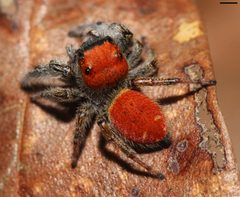
Phidippus whitmani is a of jumping spider to North America, named after American zoologist Charles Otis Whitman. It displays pronounced in coloration, with males exhibiting striking red surfaces and females typically brown or reddish depending on geographic location. The species matures in late spring and is commonly associated with older mixed hardwood forests.
Pronunciation
How to pronounce Phidippus whitmani: //fɪˈdɪpəs ˈwɪtməni//
These audio files are automatically generated. While they are not always 100% accurate, they are a good starting point.
Identification
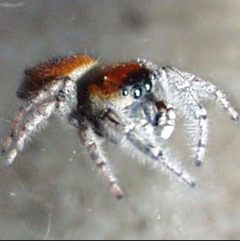
Distinguished from other Phidippus by combination of: red coloration in males (shared with P. apacheanus but with different pattern details); white abdominal band with spotted lateral band; black non-metallic with white fringe. Females may be confused with other brown Phidippus species; geographic location and precise pattern details aid identification. Definitive identification requires examination of genitalia under microscope.
Images
Appearance
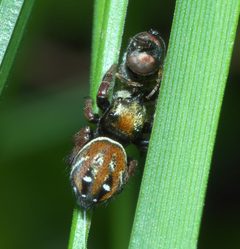
Medium-sized jumping spider with robust, densely hairy body. Males: surface of and bright red, with white band along top of abdomen and lateral band containing small black or white spots; black band in frontal region; white setae on forelegs; black with white fringe. Females: similar pattern of spots and bands, but abdomen and cephalothorax typically brown in northern range, reddish in southern range.
Habitat
Older, mixed hardwood forests; found in leaf litter and on herbaceous vegetation. Specific microhabitat preferences within forests not well documented.
Distribution
North America: United States (Florida to New York/New Hampshire, west to Colorado) and Canada (Nova Scotia, Newfoundland, Québec, Manitoba, Ontario). Ranked as apparently secure in Ontario.
Seasonality
mature in May or June; females lay in July and August. Activity period likely extends through growing season but specific details beyond are not documented.
Life Cycle
with as immatures or : spiders mature in late spring (May-June), females oviposit mid-summer (July-August), spiderlings emerge and develop through remainder of season. Specific details of sac construction, number of eggs, and developmental stages not documented.
Behavior
Active visual hunter typical of salticids; stalks prey. Specific behavioral repertoire (, territoriality, silk use) not documented for this .
Ecological Role
in forest floor and understory ; contributes to regulation of insect in mixed hardwood forest .
Human Relevance
Named for Charles Otis Whitman, American zoologist; no documented economic importance, medical significance, or conservation concern. Occasionally encountered by naturalists and photographers due to attractive male coloration.
Similar Taxa
- Phidippus apacheanusMales also have red coloration, but differ in pattern details and geographic distribution (primarily western and central grasslands rather than eastern hardwood forests)
- Phidippus audaxSimilar size and general form, but typically has bold black and white or iridescent markings rather than red coloration
More Details
Etymology
Named in honor of Charles Otis Whitman (1842-1910), American zoologist and ornithologist known for his work in embryology and animal
Conservation Status
Ranked as apparently secure in Ontario, Canada; no formal conservation assessments available for other portions of range
Sources and further reading
- BugGuide
- Wikipedia
- GBIF taxonomy match
- iNaturalist taxon
- Catalogue of Life
- Bug Eric: Spider Sunday: Phidippus octopunctatus
- Bug Eric: Spider Sunday: Phidippus asotus
- Eriopis connexa on soybean in Argentina | Beetles In The Bush
- Bichos Argentinos #6 – Jumping Spider | Beetles In The Bush
- Bug Eric: Spider Sunday: Apache Jumping Spider
- quiz | Beetles In The Bush | Page 2